

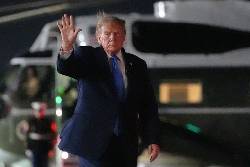
WASHINGTON (AP) — The extraordinary showdown between President Donald Trump and media outlets whose coverage he dislikes moved Wednesday to a courtroom in the nation’s capital, where a judge is hearing arguments on whether the president’s move banning three news organizations from White House grounds violates the Constitution.
The administration has doubled down on its contention that it has the right to decide who can set foot in the White House. “Access to the White House is a privilege — not a right,” it said in a court filing late Tuesday.
It also argued that the reporting of the three outlets — CNN, MS NOW and Politico — poses a threat to national security. In his early comments about the case, Trump focused not on national security but on negative coverage by the outlets and allegations of “fake news.”
The proceedings are historic, said Katie Fallow, deputy litigation director at the Knight First Amendment Institute at Columbia University.
“No president has taken this explicit of a step” to ban entire news outlets because he doesn’t like their reporting, she said. “There have been various presidents throughout history who have grumbled about the press or threatened to take more major steps, but really there was nothing at this level before Trump.”
The case is being heard by U.S. District Judge Timothy Kelly, whom Trump appointed in 2017 and who ordered a CNN journalist’s access restored in a similar case in 2018.
The Trump administration outlined ‘reporting incidents’ of each news outlet
In the filing, administration lawyers argued that the ban does not violate the First Amendment, which guarantees the right to a free press. It contended that the outlets, in their reporting, violated “standards of professionalism and decorum expected of those given access to the White House complex, including by trafficking in verifiable falsehoods about national security and other issues and publishing sensitive or classified information.”
The administration went on to detail letters that were sent to each outlet that identified “a non-exhaustive list of reporting incidents, including those that have threatened national security and spread falsehoods.”
The “reporting incidents” cited in the filing included: CNN reporting on “‘top-secret' construction details related to the East Wing bunker”; MS NOW reporting “on an alleged leak investigation”; and Politico publishing “a document detailing funding for the White House ballroom containing intricate descriptions of how the Secret Service would invest in security improvements.”
Further examples were given in individual letters. Politico’s letter detailed six incidents of reporting, including in June citing a “senior administration official … granted anonymity” predicting whether a preliminary deal would end the conflict with Iran.
That item appeared to reference a background briefing set up by the White House, where an official briefed reporters on condition of anonymity under ground rules set by the White House itself. Several other outlets also reported the official's remarks.
The news outlets argue that the ban blatantly violates the First Amendment
Trump began to emphasize the national security argument Tuesday, when he said negative coverage was dangerous for the country.
“I think we have a right to clean out fake news,” he told reporters at the United Nations, defending the ban, which was suddenly announced Friday. The next day, journalists for the three outlets arrived at work to find their entry badges disabled.
On Monday, the outlets filed their joint lawsuit, alleging they were singled out because of the content of their coverage — in other words, viewpoint discrimination. They called this a “blatant violation” of the First Amendment and asked the court to immediately restore their access.
The ban prompted other media outlets to take action in solidarity. The five-network U.S. network press pool — a rotating cast of news outlets that covers the president, and to which CNN belongs — decided to suspend coverage of Trump events until further notice. The Associated Press joined a group of organizations that refrained from publishing photos of the president Monday. On Wednesday, the network pool was again missing from a daily White House press schedule.
The ban and subsequent lawsuit are part of a long-running conflict between the president — especially in his second term — and media outlets he finds unfavorable. Trump has responded in the courtroom, or with regulatory action. He’s also lashed out at individual reporters in personal terms.
Trump filing gives anecdotes on past presidents
The administration’s filing to the court also relies on historical anecdotes to argue that a president can decide which news outlets to grant favorable treatment.
It says, citing books on the subject, that in the early 20th century, President Theodore Roosevelt “began a practice of regularly inviting reporters into the Oval Office for off-the-record press conferences while he received his ‘regular midday shave,’” and adds that Roosevelt “used the conference as an occasion for reward and punishment, screening out the reporters who were the least likely to be sympathetic to his policies.”
It also says President John F. Kennedy “sought to ‘court star correspondents’ and thus gave certain reporters ‘special access’ and ‘advance notice of administration announcements.’”
Other news outlets file a brief to the court in support of colleagues
An amicus brief was filed by other news groups Wednesday, urging the court to immediately restore the three outlets' White House access.
The brief — filed by the Reporters Committee for Freedom of the Press, the White House Correspondents' Association and 49 media outlets and industry groups, including The Associated Press, The New York Times and Reuters — says “the targeted expulsion of news media from White House grounds injures the public interest" and that "unassailable First Amendment law makes any viewpoint-based decision to bar reporters from a nonpublic forum constitutionally repugnant.”
___
Noveck reported from New York. Associated Press journalist Laurie Kellman contributed from London.
... Copyright © 1996 - 2026 CoreComm Internet Services, Inc. All Rights Reserved. | View our