

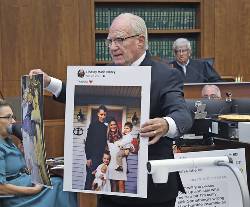
PLYMOUTH, Mass. (AP) — The defense in the Lindsay Clancy trial told a judge Thursday on the sixth day of deliberations that one juror should be removed from the panel for refusing to follow instructions on reasonable doubt. Instead, the judge sent the jury back to continue deliberations. The deadlocked jury has twice told the judge in the past two days that they can’t agree whether Clancy is criminally responsible for killing her three children. If jurors ultimately cannot agree on a verdict, the judge could declare a mistrial.
Clancy, a 36-year-old former labor and delivery nurse, doesn’t deny strangling her children in the basement of their home in 2023. Her attorney argues that postpartum psychosis led to her actions, while prosecutors say she knew what she was doing.
Postpartum psychosis is estimated to afflict 1 to 2 per 1,000 women after delivery. Experts at the Cleveland Clinic describe it as a mental health emergency affecting someone’s sense of reality. Though most people with postpartum psychosis don’t harm their children, mothers with severe cases may try to do so.
Here’s the latest:
Judge says he’s given his instructions, and the jurors have sworn to honor them
The deadlocked jury twice told the judge in the past two days that they can’t agree whether the Massachusetts mother is criminally responsible for killing her three children.
Reddington now said a juror apparently is not following the judge’s instructions on reasonable doubt and he wants the juror kicked off the panel.
“If we come back here in a half-hour with a mistrial because of a juror that has just spurned the instructions of this court, it’s a shame — it’s a real shame,” Reddington said.
But prosecutor Jennifer Sprague said the judge’s instruction was appropriate and no further action was necessary.
“I’ve asked if they’ve been able to follow my instructions. They swore earlier that they could,” Sullivan said.
Reddington says there’s one juror ‘who refuses to listen to the law’
Clancy’s defense lawyer has asked the judge to remove one juror who he says has “spurned” the instructions of the court.
“There is one juror who refuses to listen to the law you have given him or her on reasonable doubt” Reddington said.
The judge responds that it’s not appropriate for him to rule one way or another.
“I don’t think it’s appropriate for me to say I agree with one juror or 11,” says Sullivan.
The judge said “the defendant’s objection is noted” and sent the court into recess as deliberations continue.
Gasps in the audience
Once the judge asked the jurors to resume deliberations, some in the audience gasped.
The jurors showed no visible emotion at the instruction, nor did Clancy’s family.
At the sidebar, Reddington is talking to the judge and waving his arm in the air.
Judge reminds jurors about the rules for reasonable doubt, and sends them back
“I want to remind you that you are required to follow my instructions on the law as I gave you,” he told them.
“It is not enough for prosecutors to show a probability, or even a strong probability, of guilt,” the judge said.
Proof beyond a reasonable doubt does not mean proof beyond all possible doubt, the judge added.
And then he sent them back into the jury room.
Sidebar over, the jury is reentering the courtroom
Reddington sighed, crossed his arms and walked back to the defense table. Clancy and the other attorneys returned to their respective seats as well.
The courtroom is silent except for the sound of reporters typing on their keyboards.
The jury has now been called back into the courtroom.
The judge continues to have short conversations with each juror
Once each juror speaks to the judge, they are taken back out of the courtroom. Reddington is standing behind Clancy, who is about three feet from the jurors as they are brought in.
Jurors are being brought back into the courtroom
The jurors are entering one by one, and being sworn in. The judge is talking to each juror, but it’s not yet clear what they are talking about. Each one then leaves the courtroom.
Now Clancy has joined the sidebar.
Reddington held his hands at his side, looking out at the courtroom, and then sighed as he walked over to confer with Clancy before wheeling her up to join the sidebar. It’s the first such meeting for her in this trial.
Reddington puts his hands on Clancy’s shoulder and she turned to talk to him. Now Reddington is speaking to the judge, slicing the air with this hand.
Two court officers have also joined the sidebar, which has now stretched past the 10 minute mark.
Sidebar discussion between judge and attorneys is animated
The discussion between the judge and attorneys on both sides is impassioned, with Clancy’s attorney Reddington pointing his finger for emphasis and the judge handing him a document.
The sidebar conversations are intended to be private, not done in front of a jury or on a court livestream. The court is playing a white noise machine to help prevent anyone from overhearing the conversation.
The discussion has gone on for at least five minutes, making it one of the longer sidebars since the trial began.
Court is back in session
Judge William F. Sullivan entered the courtroom and called the lawyers to a sidebar. He didn’t explain what they would be talking about. That has been the judge’s practice, to speak to the lawyers first in private before explaining to the room what is happening. The jury is not present.
Action inside the courtroom
The courtroom has been reopened to journalists and spectators, which has been done when the court plans to go back into session. The courtroom is packed with every seat taken.
Plymouth District Attorney Timothy Cruz and other members of the district attorneys office are in court. Defense attorney Kevin Reddington is here too, alongside Clancy in her wheelchair.
Clancy’s parents, Paula and Mike Musgrove, are sitting next to her sister, Allison Ozga. A priest from a Duxbury church is next to Clancy’s father.
Some trial watchers want Clancy held accountable
The public appears polarized about Clancy, with both harsh criticism and supportive comments teeming online. Many believe she should be punished for what she did, while her sympathizers say a criminal case should never have been filed.
Rhonda Gonsalves was at the courthouse on Monday calling for a conviction, in contrast to the many Clancy supporters who have attended the trial. The Plymouth resident wore white in honor of Clancy’s children.
“White for innocence. They’re the only innocent ones here, you know, I think anyways,” she said. “She should be found guilty for what she did to her kids. … She murdered three children.”
Trial has changed some minds about Clancy
Jeanne DeSanto said she first assumed Clancy was a horrible person for killing her kids, but watching the trial online changed her view.
“And then, no — it’s women’s health, it’s mental health, it’s systemic. It’s way bigger, and I’ve completely shifted,” she said Thursday, her first day coming to the courthouse.
DeSanto said that if a mistrial is declared, she wants to participate in a letter-writing campaign to Massachusetts Gov. Maura Healey and the district attorney, urging them to stop pursuing the criminal case.
“She’s not a danger to anyone other than herself — no one else,” DeSanto said. “What’s the point?”
She hopes Clancy could eventually become an advocate for changes in postpartum mental health care, including better communication between providers.
Women who have experienced postpartum mental illness join wait for verdict
Emily Collins came to the courthouse for the first time Thursday after having watched the livestream, wearing pink clothing like other Clancy supporters there.
She said she experienced severe postpartum depression after having the first of her three children in the 1970s.
“This was all I wanted -- being a wife and mother. So I was like, what is happening to me? Very scary,” Collins said. She recalls having suicidal thoughts and struggling to get out of bed some days amid waves of depression.
Now 64 and a former social worker, Collins thinks the Clancy case should not have been brought to trial. It’s a tough one for jurors, she said.
“It’s just a polarizing subject. I don’t think they’re ever going to get everyone to agree.”
Clancy’s ex-husband hasn’t been to the trial since his testimony
Patrick Clancy was the prosecution’s first witness after opening arguments, taking the stand in late July.
He has said in interviews that he forgives his wife, whom he viewed as ill, not evil. He has since moved to New York City and remarried.
During the trial, Patrick Clancy testified about the horrific events of the day of the killings and Lindsay Clancy’s mental health deteriorating. He left the courtroom as prosecutors played his emotional 911 call.
“She killed the kids!” he was recorded yelling.
He hasn’t returned to the proceedings since testifying, but other members of Patrick’s and Lindsay’s families have been sitting together during court sessions.
Clancy gets letters of support
On his way into the courthouse, defense attorney Kevin Reddington carried a box of letters in support of Clancy “from all over the world.”
“It’s just amazing. She reads them all,” he told reporters.
Reddington said he’s ready for a second trial if this one ends with a hung jury and the prosecutor wants to try again.
“I’ve got witnesses lined up. We’re all set. So let’s go,” he said.
The wait continues
Journalists and about 20 spectators are milling about inside the Plymouth County courthouse on a rainy day while the jury deliberates. Some of the onlookers are wearing pink shirts in support of Clancy.
The livestreamed trial has generated intense interest, drawing crowds to the courthouse every day. The case has sparked deep public divisions over Clancy’s culpability and maternal mental health care after childbirth.
The jurors’ expressions were hard to read
Panel members mostly looked at the floor as they entered the courtroom on Thursday morning.
The jury hasn’t been able to agree on whether Clancy is criminally responsible
The panel has been considering whether or not Clancy is guilty of murder, or lesser manslaughter charges, or not guilty due to mental disease or defect.
A murder conviction could bring a life sentence. A not guilty verdict could result in Clancy’s continued confinement at a psychiatric hospital.
The split among the jury in terms of guilty or not guilty has not been disclosed.
The judge quizzed jurors again before deliberations resumed
Sullivan asked them if anything had happened overnight that would affect their ability to be impartial. They said no and then returned to the jury room.
Jury begins its sixth day of deliberations
The judge brought the 12 jurors and six alternates into the courtroom briefly before sending them back to the deliberation room.
What happens if the jury cannot reach a verdict?
If a verdict cannot be reached, a mistrial will be declared, and the case essentially goes back to the same status as before the trial, with Clancy charged with murder and held at a psychiatric hospital awaiting a resolution of the criminal case.
Prosecutors will decide whether to try again with a new jury. If they do, the jury selection process will begin again, and a new trial will be scheduled.
Prosecutors could also offer a plea deal to Clancy, said Brad Bailey, a Boston defense attorney and former prosecutor who is not involved in the case.
“Any time the threat of a retrial with murder one hanging over the client is re-interjected, defense lawyers will, at the very least, explore whether or not there’s any interest in a resolution,” Bailey said.
What to know about postpartum psychosis
Postpartum psychosis is estimated to afflict only 1 to 2 per 1,000 women after delivery. Experts at the Cleveland Clinic describe it as a mental health emergency affecting someone’s sense of reality.
It can happen to anyone after giving birth, but the chances are higher for people with certain mental health conditions. In a journal article on the subject in 2023, researchers at the Medical University of Lublin in Poland said about half of people with postpartum psychosis have a previous history of psychiatric problems and the most common risk factor associated with the condition is bipolar affective disorder, which causes extreme mood swings.
Though most people with postpartum psychosis don’t harm their children, mothers with severe cases may try to do so, and also may try to harm themselves.
Experts say it’s important to seek immediate help if you or your partner or family member show signs of postpartum psychosis.
▶ Read more
A Massachusetts woman was charged with filming the jury
Dawn Light, 56, was arraigned on an intimidation charge Wednesday at the same courthouse as Clancy’s trial. Authorities say she filmed jurors leaving the courthouse a day earlier.
Light, a retired nurse and Clancy supporter, told reporters she was there: “To see Lindsay. And I did see her. She was getting picked up by the van.”
Her lawyer Jennifer White called it a “misunderstanding.”
A not-guilty plea was entered on Light’s behalf and she was ordered to stay away from the court, jurors and witnesses.
The arrest prompted the judge to ask each juror Wednesday if they saw anything that would affect their impartiality, Clancy’s attorney Kevin Reddington told The Associated Press. The judge also opened the day’s proceedings with a warning that he had issued an order governing how people should conduct themselves at the courthouse. That order barred people from filming, following, contacting or tampering with jurors.
The jury has not been able to agree on a verdict
On Wednesday, the jury sent the court a note saying it couldn’t unanimously agree on a verdict, despite days of trying. The jury had sent a similar note Tuesday morning. Neither note revealed anything about how the jury might be split or said anything about the tone of deliberations.
Sullivan then gave the jury a legal instruction sometimes known as a “dynamite charge” because it is intended to help a jury break through an impasse.
He told the jurors not to abandon their own convictions just to reach a verdict, but urged them to seriously consider opposing views and reassess their positions if appropriate. No one knows, he added, whether another jury would be “more intelligent, more impartial or more competent to decide it than you are.”
Such instructions are common in many states and the U.S. Supreme Court has upheld their constitutionality, but they are barred in some states because of concerns they might be coercive.
Jurors return for a sixth day of deliberation
Jurors in the Lindsay Clancy trial will return for a sixth day of deliberations after twice saying they couldn’t agree whether the Massachusetts mother is criminally responsible for killing her three young children.
The judge told jurors to keep deliberating Wednesday when they said for a second straight day that they were at an impasse — a sign there’s a growing chance of a hung jury and the trial ending without a resolution.
Clancy, a 36-year-old former labor and delivery nurse, doesn’t deny strangling her children in the basement of their home in 2023. Her attorney argues that postpartum psychosis led to her actions, while prosecutors say she knew what she was doing when she killed Cora, Dawson and Callan Clancy, ages 5, 3 and 8 months.
“I know it’s been a long day,” Judge William Sullivan said, “so at this point, what I’m going to do is, first off, thank you for your time and commitment to this case. I’m going to ask you to come back tomorrow morning.”
Clancy stared at the jury with no expression when Sullivan earlier in the day explained to the courtroom that the jurors were at a standstill.
... Copyright © 1996 - 2026 CoreComm Internet Services, Inc. All Rights Reserved. | View our