

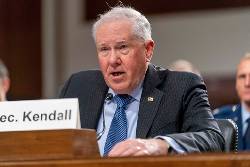
WASHINGTON (AP) — The Pentagon revoked former U.S. Air Force Secretary Frank Kendall's “eligibility” to access classified information and barred him from holding “any sensitive position," alleging Friday that he disclosed sensitive information about Air Force One's capabilities to the media.
It follows reporting last month, including from The New York Times, on security concerns over the new, Qatari-gifted Air Force One, including that it lacked the advanced antimissile capabilities of its predecessor.
Kendall told The Associated Press late Friday that he was “completely mystified” by the revocation.
“I’ve always been extremely careful to not say anything classified, and as far as I know I have not,” Kendall said. “No one has said anything to me about what I’m asserted to have revealed and I can’t imagine what it could be.”
The plane underwent a $400 million retrofit and upgrade. It has been put into service domestically and President Donald Trump also flew on it to Turkey last month. But he used an older model Air Force One jet to leave the NATO summit, as the U.S. launched airstrikes on Iran and Tehran attacked three Gulf Arab states.
The Times reported that the president made the switch at the urging of the Secret Service and that the newer plane lacked some of the advanced security features of the older Air Force One aircraft. Trump denied to reporters that the swap was due to security concerns, although he also said he is under threat "all the time” and is Iran’s “No. 1” target.
In the Times article, Kendall, who served under President Joe Biden, is quoted as saying that the time for upgrades to the plane would not have been enough for “all the normal Air Force One modifications” and he was surprised that the plane was used outside the U.S.
Kendall said Friday, “I’ve been comfortable being on the record with reporters and on national television about the Qatari 747 because I’m confident that I haven’t said anything classified.”
In response to the reporting, the Justice Department subpoenaed the Times' reporters to try to compel them to out their sources, which stirred fears over press freedoms. The department, after criticism from the judge for sloppy legal work, grudgingly withdrew the subpoenas last month.
The Air Force has argued that the rapid conversion of the jet was done “without accepting any risk regarding security, safety, or secure communications,” but it also has acknowledged the different capabilities. It said “several highly complex engineering modifications” required for the new U.S.-made Air Force One aircraft were intentionally excluded in the modifications to the plane from Qatar. The Air Force acknowledged it did not widen the doors leading out of the aircraft or include multiple stairs built into the hull of the plane.
Chief Pentagon spokesman Sean Parnell didn't specify in a post on X which media outlet Kendall was accused of sharing classified information with.
“Safeguarding classified information is a non-negotiable duty,” he wrote. “Those who violate that trust forfeit the privilege of access and any role requiring it.”
It’s not the first time the Trump administration has revoked security clearances, including of 37 then-current and former national security officials last year. Defense Secretary Pete Hegseth also pulled security protections and clearance for Gen. Mark Milley, retired Joint Chiefs of Staff chairman, soon after the administration took office.
Parnell didn't say if Kendall was being referred for prosecution, and the Pentagon declined to provide more information. Typically, such accusations are partnered with referrals for prosecution over violations of the Espionage Act.
A well-known example was when the Obama administration filed charges against Edward Snowden, a former intelligence agency contractor who publicly disclosed a massive trove of secret documents about U.S. surveillance operations before fleeing to Russia.
More recently, a federal judge sentenced a Massachusetts Air National Guard member to 15 years in prison in 2024 for leaking classified military documents about the war in Ukraine. That was the most consequential national security breach in years.
... Copyright © 1996 - 2026 CoreComm Internet Services, Inc. All Rights Reserved. | View our