

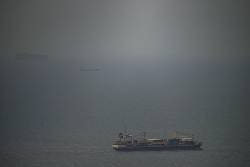
Confusion deepened Wednesday in the Strait of Hormuz as Iran attacked three ships near the crucial waterway whose closure has plunged the world into an energy crisis after tankers carrying a fifth of the world’s oil were blocked from using the channel.
The attacks unfolded just a day after U.S. President Donald Trump said he would extend the two-week ceasefire with Iran. The Islamic Republic said it fired on three outbound ships and seized two, calling it retaliation for the American naval blockade of Iranian ports and for the U.S. firing on and seizing an Iranian ship that did not stop when hailed by a vessel enforcing the blockade.
Attacks on shipping dwindled starting in mid-March as Iran imposed effective control over the strait. The mere risk of attack was enough to deter ships from trying to get through, while a few ships used an Iranian-approved lane near the coast. Iran demanded details on cargo, ownership and crew and, on at least some occasions, imposed a $1 per barrel tax on oil and oil products — or $2 million for a large tanker.
Here is a look at what’s known, and not known, about the situation in the strait:
After a pause, attacks on shipping have resumed
Iran’s semiofficial news agencies reported that the paramilitary Revolutionary Guard attacked a third ship Wednesday in the strait. Nour News, Fars and Mehr all reported the attack by the Guard on a vessel called the Euphoria. They said the vessel had become “stranded” on the Iranian coast, without elaborating. The Guard seized the other two ships that were attacked, Iranian state television separately reported.
That incident followed two ship attacks on Saturday that ended a lull that began in mid-March.
The seized ships were the Liberia-flagged Epaminondas and the Panama-flagged MSC Francesca, both container ships. It was not clear under what terms the ships were trying to pass the strait. The MSC shipping company did not answer an email asking about the vessel.
The attacks follow a sudden reversal in the Iranian stance over the weekend, as the Iranian foreign minister announced Friday that the strait was open, only to be contradicted the next day by the Revolutionary Guard. Six cruise ships stuck in the Persian Gulf since late February took advantage of the narrow window and slipped through the strait. But since then, traffic has dried up.
The resumption of attacks reflects in part “genuine confusion ... about when passage is permitted," said Torbjorn Soltvedt, principal Middle East analyst at risk intelligence company Verisk Maplecroft.
Conflicting statements emerged from Trump about a full reopening and from the Iranian foreign minister about a limited reopening. Then things “shifted very quickly” Saturday when the Guard said the strait was closed.
Additionally, Soltvedt said, it's in Iran's interest to keep insurance premiums high with sporadic attacks. “Their main leverage in negotiations with the U.S. is being able to restrict shipping through the Strait of Hormuz, and insurance is a big part of that.”
Some vessels have passed the Iranian vetting system, and some have relied on diplomatic requests from home governments. But hundreds of ships and thousands of crew members are still stuck.
The US is enforcing a blockade, but some Iranian oil gets through
The U.S. Navy boarded and seized a large tanker carrying Iranian oil south of the Bay of Bengal in the Indian Ocean, some 2,000 miles from the strait. That underlined the U.S. power to seize vessels that violate the blockade well after they have left the vicinity of the strait.
The U.S. military, which is enforcing the blockade in the Gulf of Oman and the Arabian Sea, well way from Iranian drones and speedboats, says it has turned around 20 Iran-linked vessels.
However, shipping intelligence companies say that a number of ships carrying Iranian oil have passed the blockade. Lloyd’s List Intelligence says “a steady flow of shadow fleet traffic” has passed in and out of the gulf, including 11 tankers with Iranian cargo that have left the gulf outside the strait since April 13.
“The dilemma for the U.S. is: The tighter the blockade, the greater the pain is in the global oil market, so there are conflicting priorities there, and it seems there is a policy of not intercepting every single shipment of Iranian oil,” Soltvedt said.
Additionally, almost all that oil is going to China, and the U.S. has to manage that relationship as well, with Trump planning to visit from May 14 to 15.
Capt. Tim Hawkins, the spokesman for U.S. Central Command, confirmed Wednesday that the military blockade is against all Iranian ships entering or leaving Iranian ports. However, he said humanitarian shipments, including food, medical supplies and other goods essential for civilians, are being permitted subject to inspection.
Hawkins pushed back on outside reports of ships getting past the U.S. dragnet and pointed to remarks by the head of U.S. Central Command, Adm. Brad Cooper, who claimed Friday that “no ship has evaded U.S. forces.”
Reopening the strait will take time
Ship owners and insurers will need more than a simple announcement of a peace deal to venture through the strait as they did before the war.
Even when the war ends, analytical and data firm Rystad Energy says, it will take six to eight weeks just to reposition the world’s tanker network. Ship owners and insurer would need two to five weeks to get comfortable with a new operating environment and to resume normal activity.
Ship owners will want “something that's a bit more concrete than what we have now,” Soltvedt said. “What is needed is something more comprehensive” than an informal truce with the two sides far apart on key issues such as Iran's nuclear and ballistic missile programs.
“Even then, shipping companies will have the long-term threat hanging over them" given Iran's missile and drone capabilities, he said. “They can play this card again in the future."
___
Associated Press Writer Konstantin Toropin contributed to this report.
... Copyright © 1996 - 2026 CoreComm Internet Services, Inc. All Rights Reserved. | View our