

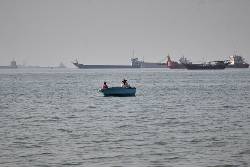
DUBAI, United Arab Emirates (AP) — A ship anchored off the United Arab Emirates was seized and taken toward Iran and another — a cargo ship near Oman — sank after being attacked, authorities said Thursday, as tensions escalated near the Strait of Hormuz.
It wasn't immediately clear who was behind these incidents, but they happened as a senior Iranian official reiterated his country’s claim of control over the waterway and another said it had a right to seize oil tankers connected to the U.S.
The turmoil in the strait, which a fifth of the world’s oil passed through before the war, has been a sticking point for weeks in talks between the U.S. and Iran to end the conflict. Iran's grip on the vital waterway has jolted the world economy and spiked fuel prices far beyond the Middle East.
The ongoing instability in the region comes as U.S. President Donald Trump met with Chinese leader Xi Jinping in Beijing. The White House said both sides had agreed that the Strait of Hormuz must remain open.
Just last week, tensions flared in the strai t when U.S. forces fired on and disabled Iranian oil tankers that it said were trying to breach its blockade of Iran’s ports.
Seizures and attacks in Hormuz ongoing
The United Kingdom Maritime Trade Operations center said it received reports that the ship seized Thursday was taken by unauthorized personnel while anchored 38 nautical miles (70 kilometers, 44 miles) northeast of the UAE port of Fujairah, an important oil export terminal that has been repeatedly attacked during the war with Iran.
The U.K. maritime center did not name the ship seized Thursday and said it is investigating. The British military said the vessel is heading toward Iranian waters.
Indian authorities said Thursday that an Indian-flagged cargo ship sank off the coast of Oman after an attack sparked a fire aboard the vessel while it was en route from Somalia to Sharjah, another UAE port. They did not say who attacked the ship.
The attack on the Indian-flagged cargo ship Haji Ali occurred Wednesday, according to Mukesh Mangal, a senior official in India’s shipping ministry. He said all 14 Indian crew members were rescued by Oman’s coast guard and were safe.
India’s foreign ministry called the incident “unacceptable” and condemned continued attacks on commercial shipping and civilian mariners. The ministry did not identify who carried out the attack.
Seizures come at tense diplomatic moment
Iranian semiofficial news agencies reported that Chinese ships began passing through the strait Wednesday night under new Iranian protocols. According to the reports, Tehran agreed to facilitate the passage of several Chinese vessels after requests from China’s foreign minister and Beijing’s ambassador to Iran. The ships began their passage as Trump arrived in China.
The seizure of a ship off the coast of the UAE happened hours after Prime Minister Benjamin Netanyahu announced he had quietly visited the country during the Israeli-U.S. war with Iran, though the UAE swiftly denied it.
The Gulf nation normalized relations with Israel in 2020. Iran has criticized that agreement and has repeatedly suggested over the years that Israel maintained a military and intelligence presence in the UAE.
Israeli leaders have made occasional visits to the UAE in recent years after normalizing relations.
Netanyahu’s decision to go public with the sensitive meeting was likely an effort to drum up local support for his flagging party ahead of Israeli elections, said Yoel Guzansky, a senior researcher at the Institute of National Security Studies, a defense think tank in Tel Aviv.
“It’s amazing, it’s the deepest cooperation we’ve ever had … that during a war, Israel is defending an Arab state against Iran. It shows how complicated the Middle East is,” he said.
The UAE is trying to highlight its cooperation with Israel but not with Netanyahu and his government, Guzansky said, because many in the UAE are against Israel’s policies in Gaza.
“They’re trying to differentiate between security cooperation and cooperating with this government,” said Guzansky, who previously worked for the national security council within the Israeli prime minister's office.
Iran sets demands for new talks
Iran said it will not enter more talks with the United States unless five conditions are met, including paying reparations for the war and accepting Iran’s sovereignty over the Strait of Hormuz, Iran’s semiofficial Fars news agency reported, citing an informed source.
The White House is again unlikely to accept those demands, which would essentially formalize Iran's control over a waterway that was open to international traffic before the war.
Iran’s senior vice president, Mohammadreza Aref, said Thursday that the strait belongs to Iran and that Tehran would not give it up “at any price,” state TV reported. “It has always been our property,” Aref said.
Iran defends right to seize ships
Iran’s judiciary spokesperson told the state-owned Iran Daily newspaper on Thursday that Iran has the legal and judicial right to seize oil tankers in the strait that are connected to the U.S. because the U.S. has violated international maritime laws and committed piracy. The spokesperson, Asghar Jahangir, did not explicitly refer to the tanker seized on Thursday.
Iran seized a number of ships, including a tanker identified as the Ocean Koi, last week, saying it was attempting to disrupt oil exports and Iranian interests, according to the official IRNA news agency. It said the tanker was seized in the Gulf of Oman and was carrying Iranian oil when it was boarded and taken to Iran’s southern coast.
The U.S. sanctioned the Ocean Koi in February as part of a “shadow fleet” that has been transporting Iranian oil.
__
Lidman reported from Tel Aviv, Israel. Natalie Melzer in Nahariya, Israel, and Sheikh Saaliq in New Delhi contributed to this report.
... Copyright © 1996 - 2026 CoreComm Internet Services, Inc. All Rights Reserved. | View our