

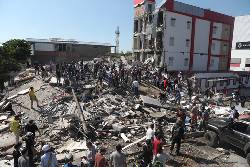
CALI, Colombia (AP) — A powerful 7.4 magnitude earthquake struck western Colombia on Monday, killing at least 111 people, damaging hundreds of buildings and leaving many trapped under debris while their loved ones and rescue workers searched through rubble.
Search teams and civilians picked through the remains of destroyed buildings in the country’s third-largest city, Cali, passing large pieces of concrete and other rubble down a long line of volunteers.
“Our building has basically been left in ruins, and the building next to ours? Completely collapsed,” said Álvaro López, who cradled his dog as he watched the search. The desperate scene recalled the searches still ongoing in neighboring Venezuela weeks after that country was devastated by two powerful earthquakes.
Besides Cali, the quake ravaged cities across western Colombia, including Pereira, Quibdo and Manizales, and was felt in neighboring Ecuador and Panama. The epicenter was in San Jose Del Palmar, a community of about 4,800 people in the Choco region about 250 miles (400 kilometers) west of Bogota, the U.S. Geological Survey said.
Colombia’s President Abelardo de la Espriella said at least 87 people were injured and around 1,600 buildings were damaged, including at least 61 that completely collapsed. He declared an emergency to expedite funding for the quake recovery while saying he would visit the disaster zone.
“We aren’t going to leave people alone. They are in our hearts and we are going to tend to people with our full determination,” he said.
Most powerful quake recorded in Colombia this century
Colombia’s Geological Service said Monday's quake was the country's strongest recorded “in the 21st century,” and that it was followed by 21 less powerful aftershocks.
Colombia’s Pacific region around the quake's epicenter lies along the “Ring of Fire," the line of seismic faults encircling the Pacific Ocean where most of the world’s earthquakes occur. The Pacific, particularly the Choco region, is one of Colombia's poorest, nestled in dense jungle. Much of Choco is only reachable by boat or plane, which may pose a problem for authorities in assessing the wider toll.
Local authorities said the death toll included at least 40 people who were killed in the Risaralda region, where Pereira is located, and 27 people in the Valle del Cauca region, where Cali is located, including three children. Authorities also confirmed nine people killed in Choco, two in the Caldas region and a 73-year-old in the Antioquia region. It was not immediately clear where the other 32 people died.
The earthquakes left many in the Andean nation unnerved after two back-to-back quakes devastated neighboring Venezuela in late June, destroying hundreds of buildings and killing more than 6,300 people.
By Monday afternoon, people had begun reporting their loved ones missing on digital databases just as civilians did following Venezuela's earthquakes. One database had more than 1,400 people, mostly in Cali and Pereira, with the number steadily climbing.
Photos of the missing included a young mother and her baby in Pereira; another showed an 80-year-old woman in Cali whose family was desperately looking for details after her building collapsed.
Cities left devastated
Jorge Moncayo, a 64-year-old taxi driver in Cali, said he saw plumes of dust shoot up across the city as buildings collapsed. Residents and rescue workers were searching the rubble for survivors. The local government said that people remained trapped in a number of the city's 380 damaged buildings.
“My entire house shook. I’ve never lived through such a powerful earthquake,” he said. “We’re thanking God we’re alive.”
Little was known about the extent of the damage in Choco, a remote region where officials reported dozens of injured people and damaged buildings but few other details. Phone signals were out in many parts of the region's capital, Quibdo. The town closest to the earthquake’s epicenter, San Jose del Palmar, has no airport, and is located on top of a mountain ridge along a highway linking the cities of Cali and Pereira.
In Pereira, further south in the coffee-producing mountains of Colombia, photos and videos on local media showed pieces of the airport ceiling falling down on travelers taking shelter and screaming. People were shown running through rubble and plumes of dust and residents said that the city was lined with collapsed stores, residential buildings and homes. Pereira's mayor, Mauricio Salazar, told a local radio station there were at least 15 collapsed buildings where people were feared trapped.
In nearby Manizales, one of the towers of the neo-Gothic cathedral collapsed and fell on the nave. Mayor Jorge Eduardo Rojas asked residents to stay outside in case of aftershocks. Authorities said flights were suspended in the airports of Manizales, Quibdo, Armenia, Cartago, Buenaventura and Pereira as they assessed damage.
Offers of aid from across the Americas
Small earthquakes, known as “temblores,” are common in central and western Colombia, but those above 6.0 magnitude are rare. In 1999, a 6.2 magnitude quake near the city of Armenia killed more than 1,100 people.
Response to the earthquake presents the first major challenge to de la Espriella, a Trump ally who was sworn in as president over the weekend. A divisive figure because of his pledge of a all-out crackdown on criminal groups, de la Espriella said Monday he had personally taken charge of the government’s response to the emergency.
“You are not alone. The state is present and taking action,” he said.
Offers of aid quickly poured in from across the Americas, including from the United Nations and the Trump administration. El Salvador’s President Nayib Bukele and Mexican President Claudia Sheinbaum — whose countries were among the largest providers of aid to Venezuela following its recent crisis — said they were ready to assist Colombia.
"From El Salvador, we are in communication and ready to provide immediate support with our rescue teams, medical personnel, paramedics, supplies, or any other assistance that our Colombian brothers and sisters deem necessary,” Bukele said.
Chilean President José Antonio Kast said Chile, one of the region’s most earthquake-prone countries, “knows the pain and the challenge left by earthquakes” and pledged help.
——
Suárez reported from Bogotá and Janetsky reported from Mexico City. Associated Press journalists Manuel Rueda in Bogotá, Edith M. Lederer at the United Nations and Matthew Lee in Washington contributed.
... Copyright © 1996 - 2026 CoreComm Internet Services, Inc. All Rights Reserved. | View our