

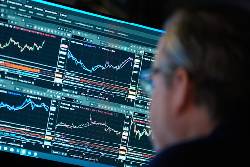
BANGKOK (AP) — European shares slipped Thursday despite rebounds in Asia and on Wall Street, as Iran launched new attacks and threatened the U.S.
U.S. futures also fell back, with the contract for the Dow Jones Industrial Average losing 0.5%, while that for the S&P 500 shed 0.3%.
Uncertainty about the war in the Middle East has been rattling financial markets, with most taking their cues from what the price of oil is doing.
“Yesterday’s bounce in risk assets already looks less like a turning point and more like a classic relief rally in a market that briefly inhaled before realizing the room was still on fire,” Stephen Innes of SPI Asset Management said in a commentary.
Crude prices climbed early Thursday, with Brent, the international standard, gaining 3.2% to $84 per barrel. U.S. benchmark crude jumped 3.7% to $77.37 per barrel.
The war brought a fresh wave of attacks by Iran on Israeli and American bases. Iran warned the United States would “bitterly regret” torpedoing an Iranian warship in the Indian Ocean and a religious leader called for “Trump’s blood,” while Israel said it had begun a “large-scale” attack on Tehran.
In Germany, the DAX lost 0.5% to 24,087.63, while the CAC 40 in Paris lost 0.6% to 8,118.25. Britain's FTSE 100 edged 0.2% lower, to 10,547.82.
In Asian trading, South Korea’s Kospi took back much of its historic losses from a day earlier, jumping 9.6% to 5,583.90. It had gained as much as 12% earlier in the day as investors hunted bargains, triggering temporary trading halts.
The government announced emergency measures for the economy after the benchmark fell by the most ever in a single day on Wednesday. President Lee Jae Myung urged officials to activate an emergency financial package worth 100 trillion won ($68.5 billion) aimed at calming market volatility.
Tokyo's Nikkei 225 index gave back some early gains, closing 1.9% higher at 55,278.06.
In Hong Kong, the Hang Seng climbed 0.3% to 25,321.34 after Chinese Premier Li Qiang opened the annual session of the National People's Congress with a report that set the annual target for economic growth this year at 4.5% to 5%. A draft budget put the increase in military spending at 7%, down from 7.2% in recent years.
The government pledged to support the sluggish domestic economy and spur more consumer spending, but did not announce any major new stimulus.
The Shanghai Composite index gained 0.6% to 4,108.57.
In Australia, the S&P/ASX 200 rose 0.4% to 8,940.30, while New Zealand's benchmark rose 0.6%.
Taiwan's main share index gained 2.6%.
On Wednesday, U.S. stocks got a boost as oil prices steadied, albeit temporarily. A report that said growth for U.S. businesses in the real estate, finance and other services industries accelerated last month at the fastest pace since the summer of 2022 also helped.
The S&P 500 rose 0.8%, erasing much of its losses since the war with Iran began. The Dow industrials added 0.5% and the Nasdaq composite climbed 1.3%.
Another report suggested U.S. private sector employers stepped up hiring last month, a potentially hopeful signal for a more comprehensive U.S. government Friday about the overall job market.
Investors are worried over how long the war with Iran could last, how high inflation may go because of more expensive oil and how much damage that might do to corporate profits.
Wall Street also got a lift from Big Tech stocks as Amazon rose 3.9% and Nvidia added 1.7%. Because they’re among the biggest stocks in the U.S. market in terms of total value, their movements carry more weight on the S&P 500.
Wednesday’s strong reports on the economy were welcome news for the Federal Reserve, whose job it is to keep the U.S. job market healthy and inflation low. The Fed’s job has become more difficult because of the jump in oil prices, which is pushing upward on already high inflation.
In other dealings early Thursday, the U.S. dollar rose to 157.22 Japanese yen from 157.07 yen. The euro fell to $1.1596 from $1.1636.
The dollar has advanced against other currencies partly because the U.S. is viewed as facing less risk from the war than other countries, analysts said.
“When the world becomes less certain, capital gravitates toward the deepest pool of liquidity available,” Innes said, adding that the dollar “remains the market's preferred storm shelter.”
___
AP Writer Kim Tong-hyung contributed.
... Copyright © 1996 - 2026 CoreComm Internet Services, Inc. All Rights Reserved. | View our