

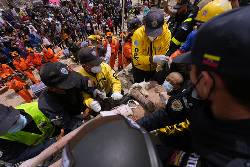
LA GUAIRA, Venezuela (AP) — Local and international rescue teams raced against the clock to pull survivors from the rubble in Venezuela on Sunday, four days after two powerful earthquakes shook the northern state of La Guaira.
The government reported 1,450 dead from the quakes Sunday afternoon as it faced growing criticism from Venezuelans that its response was inadequate and overshadowed by civilian-led efforts to rescue people buried under collapsed buildings.
Thousands have been reported missing, according to multiple databases used by families searching for loved ones.
Even as the likelihood of finding people alive diminished with each passing hour, rescuers continued to free some survivors from mountains of debris, offering anguished families a sliver of hope. The first 48 to 72 hours after a natural disaster are crucial to rescue efforts, though survival can be extended if people have access to food and water.
More than 2,200 rescue workers from across the world had arrived by Saturday, the U.N. said, and more were still arriving. As the stench of decomposing bodies spread, more people began to wear masks.
“It’s been incredibly hard work, but we’re going strong,” said Jason Mercano, a civilian who was able to communicate with family buried under the rubble via social media.
“We've never given up hope,” he added.
Masses of people gathered to watch as rescue crews from the U.S. and France pulled a man and his son from the ruins Sunday morning and carried them carefully on a black tarp into an ambulance.
Venezuelans cope with tragedy
Still, many Venezuelans are struggling to hold onto hope in an increasingly desperate situation. The one-two punch of 7.2 and 7.5 magnitude earthquakes that hit last Wednesday have left a trail of devastation.
Authorities said Sunday that more than 770 buildings had totally or partially collapsed from the earthquakes, twice as many as were reported destroyed or damaged on Friday. The risk of further damage remains as aftershocks continued to shake Venezuela; quakes measuring 4.2 and 4.5 hit Sunday morning.
Many living in disaster zones said they had seen little sign of their government since the quakes. But rescue efforts in La Guaira — the hardest-hit area — appeared significantly more organized on Sunday as international rescue missions arrived en masse. In previous days, residents there had expressed frustration and anger about the level of response.
The government reported on state television that more than 14,000 members of the military and police are now patrolling La Guaira state, where access is blocked and special permits are required to enter.
Because of the chaos and shoddy cell phone service since the earthquakes, many Venezuelans have turned to non-governmental digital databases to report their loved ones as missing. More than 50,000 people were reported missing on one such database, though it is unclear how many have been found.
Solidarity and signs of life
In the seaside city of Catia La Mar, Venezuelan rescue teams called down to survivors after discovering signs of life. They shouted instructions to a man whose family watched anxiously as crews discussed how to bring him to safety.
Despite the overwhelming demand for medical services and the shortage of supplies in Venezuela’s public health system, Domingo Luciani Hospital in the capital of Caracas coped with an influx of patients thanks to a flood of donations.
“We have tons of patients, but thank god, people have responded by bringing us a great deal of supplies,” said Leomery Pérez, an anesthesiologist at the hospital.
Authorities said they had treated more than 3,100 wounded people, including many with crush injuries.
Long-term challenges
The disaster poses a significant challenge for acting President Delcy Rodríguez, the former vice president who took office in January after the U.S. capture and removal of then-President Nicolás Maduro.
Since then, the U.S. government has played in increasingly powerful role in dictating the future of the South American nation. Venezuela has faced economic disarray for more than a decade, and many people reject the legitimacy of the political movement Rodríguez represents.
The country now faces an even more difficult circumstances, said Ronal Rodríguez, researcher for the Bogotá-based Venezuelan Observatory at the University of Rosario.
“There is political interference by the United States, the operational incompetence of a government that has driven the country into a complex humanitarian crisis and, all of the sudden, an earthquake in a place that lacks human capital and short-term resources to address the situation,” he said.
The U.N. migration agency said up to 6.8 million people may be affected by the earthquakes. The International Organization for Migration said it was working with the Venezuelan government, the United Nations and humanitarian groups on a coordinated response.
“It is already clear that displacement will increase, as people seek safety,” said Amy Pope, director general.
___
Janetsky reported from Mexico City. Associated Press journalists Andry Rincón, Fernando Vergara and Matías Delacroix in La Guaira, Venezuela; Jorge Rueda in Caracas, Venezuela; Clara Preve in Buenos Aires, Argentina; and Elliot Spagat in San Diego, contributed to this report.
... Copyright © 1996 - 2026 CoreComm Internet Services, Inc. All Rights Reserved. | View our