

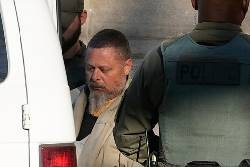
An attorney for a man serving 130 years in prison for killing two teen girls in Indiana said police were so determined to find him guilty they used confessions gathered while he suffered from psychosis and withheld from trial a witness sketch that looked nothing like him.
Jurors convicted Richard Allen of murder in 2024 in the deaths of Abigail Williams, 13, and Liberty German, 14, known as Abby and Libby. The case in the tiny town of Delphi went unsolved for more than five years before Allen was arrested, becoming a magnet for true-crime enthusiasts.
After Allen told investigators he had been on the trail near where the girls died, authorities found any way they could to convict him and make sure no evidence surfaced that any other man was on that walkway, attorney Mark Leeman told a three-judge panel of the Indiana Court of Appeals on Monday.
“We live in a world where one or two things happen here," Leeman said. "A pharmacy tech with no criminal history goes out for a walk to watch a stock ticker and look at fish and decides to gruesomely murder two girls. Or, we live in a world where the police through confirmation bias failed to find the right guy.”
Judges have plenty of questions about the trial's fairness
The three judges handling the appeal questioned why the trial judge didn't allow the defense to call an expert to testify that it looked like the girls were killed by unknown participants in a pagan ritual. They also asked why a police sketch of someone seen near the trail was omitted from trial, noting that the sketch looked nothing like Allen.
The panel also questioned why a defense expert wasn’t allowed to question whether marks on an unfired bullet can be traced to a specific gun, as prosecutors had asserted. And given that videos of Allen’s odd behavior in prison were shown to jurors, the appeals judges wanted to know why the trial judge did not allow the audio to be played as well, audio in which Allen claimed to be a king and that he had started World War III.
But the judges also asked the state several times if the decisions were harmless and whether the jury would have convicted Allen anyway even if the trial decisions being weighed had gone his way.
Indiana Deputy Attorney General Ellen Meilaender said Allen provided the strongest evidence himself when he told police before he was arrested that he was on the trail, but said he didn't see the girls.
“Allen denied seeing Abby and Libby there, even though the timeline evidence indisputably shows he must have done so, which was consciousness of guilt,” Meilaender said.
The judges will rule at a later date.
Crime scene had plenty of strange evidence
The girls’ bodies were found down a steep hill from an abandoned railroad trestle on a hiking trail just outside of Delphi on Feb. 13, 2017. The eighth graders were dropped off and never made it to their pickup point.
The teens’ throats were cut, and a few branches were scattered over their bodies. One was found nude while the other was wearing the first victim’s clothes. There was no evidence they had been sexually assaulted.
One of the girls took a brief video of a suspicious man nearby saying, “Down the hill."
Prosecutors said Allen was armed with a gun and forced the girls off the hiking trail. They said he confessed to planning to rape them before a passing van made him change his mind and kill them. An expert testified an unspent bullet found between the teens’ bodies “had been cycled through” Allen’s handgun.
Defense lawyers at his trial said no witness explicitly identified Allen as the man seen near the trail the afternoon the girls went missing. They also said no fingerprint, DNA or forensic evidence linked Allen to the murder scene. They wanted to call an expert to dispute that guns can mark bullets in unique ways, but weren't allowed.
Allen's lawyers say isolation led to mental breakdown and false confessions
Allen was held in solitary confinement while awaiting trial. He denied killing the girls for months, but his attorneys said mental stress from isolation led to a steep psychological decline. Eventually, his mental state became so bad he convinced himself he killed the girls and confessed several times, his lawyers said.
Prosecutors said the statements coincided with Allen seeing evidence in the case including the conditions of the teens' bodies.
Expert testimony of possible pagan ritual also excluded
Allen's trial attorneys wanted to put an expert witness on the stand to testify the killings appeared to be a ritual sacrifice by people who worshipped Odin, the king of the gods in Norse mythology.
The expert was expected to say the positioning of the bodies, the branches on the remains, the outdoor location of the crime and knife wounds to the victims all were indications of pagan rituals.
Prosecutors said the expert had limited examples and that defense lawyers shouldn't be able to present just any theory without evidence to back it up. They said it would have turned the trial into a sideshow.
... Copyright © 1996 - 2026 CoreComm Internet Services, Inc. All Rights Reserved. | View our