

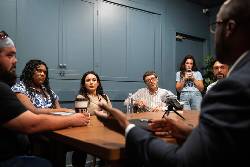
AMARILLO, Texas (AP) — When Gina Hinojosa, the Democratic nominee for Texas governor, began her campaign last year, candidates weren't talking about — or hearing about — data centers.
But with barely three months until November's contest, the perceived threat to rural life, ranchland and dwindling water supplies could become a defining issue for her longshot challenge to Republican Gov. Greg Abbott, dividing conservative rural areas that have traditionally served as a counterweight to Democrats' urban strongholds.
The backlash to energy-guzzling server warehouses that power artificial intelligence is also shaping other statewide campaigns from Arizona to Ohio to New York, and even giving Democrats a glimmer of hope in Texas, where Republicans have dominated for three decades.
“There is this little issue that I recently started hearing about that I wanted to tell you about, in case you don’t know,” Hinojosa quipped to a Democratic Party-organized crowd of about 160 seated on fold-out chairs at an Amarillo social club in Texas' panhandle. “It’s this issue of data centers.”
The crowd booed, and she went on: “They are owned by the richest men in the world. We’re all footing the bill. There are no rules. It is the wild west of data centers.”
The fast growth of massive data centers has already upended races for local offices across the country, often uniting conservatives and liberals in revolting against projects in their midst.
People don't like the secrecy surrounding the projects or the prospect of air, noise, water and light pollution. They fear electric bills going up, wells going dry and losing open space, farmland or forest.
Now the ripple effects have spread to top-of-the-ticket races, where incumbents and challengers are trying to show that they hear an angry electorate.
In Ohio, Democratic nominee Sherrod Brown aired a television advertisement attacking Republican U.S. Sen. John Husted as the "face of data centers in Ohio" as people gather signatures for a statewide referendum to outright ban their construction.
In Wisconsin, a Democratic candidate for governor, Francesca Hong, is pledging to “tax the rich, fund our schools and stop AI data centers” as she campaigns for her party's nomination in a crowded primary.
In Pennsylvania, Democratic Gov. Josh Shapiro is facing heat from some voters who feel like he's been too welcoming to tech behemoths. Sam Burleigh, a Democrat whose rural community is fighting off data center projects, accused Shapiro of “allowing these data centers to come in and take over acres and acres of prime farmland.”
Texas is fertile ground for data centers
Any political unrest may be felt most acutely in Texas.
The state is poised to overtake northern Virginia as the largest global data center market by 2030, according to a report by commercial real estate giant JLL. It has lots of land, lots of energy and a friendly regulatory environment under Republican leadership.
In rural west Texas and its panhandle, gargantuan data centers are under construction, including one near Amarillo touted as the world's largest. Some come with designs for natural gas-fired turbines to power them.
Rumors are flying about others popping up — Google, which is building four data centers in northwest Texas, sponsored moderated conversations with officials and business elite in Lubbock and Amarillo in recent weeks — and it is sowing an outcry across small cities, tiny towns and sprawling ranches where people vote overwhelmingly Republican.
Google says its investments are advancing American innovation, fortifying cybersecurity and boosting energy capacity, while President Donald Trump has made data centers a top priority to help the U.S. compete against China for AI superiority.
But tech giants and developers can be secretive about their plans, making it impossible to know what will be built or what sort of pollution they'll create, critics say. Some worry that data centers will destroy rural Texas' low cost of living and sully sunsets and sweeping views that stretch toward the horizon.
Others say construction and an influx of workers are already causing havoc for ranchers and towns, driving up rents, snapping up farmland, illuminating the night sky, clogging roads and turning parts of rural Texas into industrial zones.
Opposition crosses a partisan divide
Democrats are prominent among the data center critics, but so are Republicans, including Texas' sitting agriculture commissioner, Sid Miller. They say there are many more Republicans who are quieter because they fear publicly opposing their governor and party.
“They're upset with Greg Abbott,” said Suzanne Bellsnyder, a former Republican activist from Spearman who writes a syndicated column that advocates for rural Texas. “Whether that translates into voting against him, I don't know.”
Abbott has aggressively advocated for big projects in Texas and, in November, he helped make Google's announcement of a $40 billion investment there, saying “Texas is the epicenter of AI development.”
Compounding that, Texas counties don't have zoning authority — precisely the local land planning authority that communities around the country are increasingly using to fight off data centers.
Abbott seems to recognize that data centers are dividing his base. In recent weeks, he ordered regulators to take steps to ensure Texans weren't paying higher electricity bills because of data centers and promised to push a legislative agenda next year to impose regulations on data centers.
At an East Texas campaign stop, Abbott said that includes taking away the state's billion-dollar-plus-per-year tax break and preventing data centers from being built in “rural Texas neighborhoods.”
Hinojosa and others derided Abbott's words about “rural Texas neighborhoods” as meaningless — "doublespeak that makes no sense to anyone," Hinojosa said — and lacking urgency or seriousness.
“Now we have this gold rush of data centers in our communities," Hinojosa said in an interview, adding that “people want a say, and I think that’s fair.”
As governor, she said she'd block a permit for a data center if it wasn't a good deal for Texans or residents hadn't gotten a say in the matter.
Abbott tries to soothe concerns
Abbott's campaign season turnabout on data centers doesn't seem to have soothed many.
Of great concern is the prospect that data centers will consume massive amounts of water and worsen drought conditions for ranchers and farmers in a state where water shortages already crippled the sugar cane industry.
“Oh, I guarantee you, it's on everybody's mind,” said Giles Dalby, a cattle rancher and a Republican county commissioner in west Texas.
Dalby, who raises Angus and Brangus cattle on ranchland that's been in his family for 125 years, pointed to fast-growing cities where water authorities have had to go to greater lengths to procure water, including the “water wars” between San Antonio and ranchers several years ago.
Texas is increasingly steamrolling over landowner rights in the quest for public water, Dalby said, and that could mean that data centers get in line ahead of ranchers when shortages or rationing worsen.
Clayton Tucker, a rancher and the Democratic nominee for state agriculture commissioner, said his campaign events are consumed by talk of data centers. It doesn't matter whether he's meeting with Democrats or Republicans.
“This is the most cross-partisan issue I’ve ever seen in my life,” Tucker said.
Meanwhile, protest groups are springing up, including one in Lubbock that is led by Republicans. The founders, Stephen Sanders and Hallie Bertrand, like some other Republican opponents of data centers, say it's possible or even certain they won't vote for Abbott, although they may not necessarily vote for Hinojosa.
There is still time for Abbott to push through major legislation before the election and “be a hero,” Sanders said.
The big question is whether enough rural voters will turn against Abbott to give Hinojosa a shot. It’s hard to tell, Bertrand said, especially when some know nothing about the issue.
“They'll just hit that button, Republican all the way down,” Bertrand said. "But I think it’s a step towards something that we have not seen in Texas in a long time, with people on the right switching to the left. Or scooting a little closer to the middle, maybe."
___
Follow Marc Levy at http://twitter.com/timelywriter
... Copyright © 1996 - 2026 CoreComm Internet Services, Inc. All Rights Reserved. | View our