

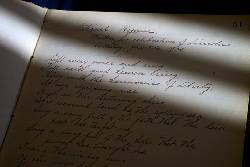
In 34 lines, James Weldon Johnson told of the pain, anguish, frustration, faith and hope that former slaves and their descendants experienced in a land and country they were forced to call home.
He did it in “Lift Ev'ry Voice and Sing,” a poem that later became a song and is now widely called the Black National Anthem. The original manuscript along with other papers by Johnson, who was Black, are held by the Beinecke Rare Book and Manuscript Library at Yale University.
Johnson wrote “Lift Ev'ry Voice and Sing” in Jacksonville, Florida, as part of a celebration in 1900 for Abraham Lincoln's birthday. His brother, John Rosamond Johnson, later composed the music. It first was performed by Black children in a Jacksonville school where James Weldon Johnson was principal.
The song was later adopted by the NAACP and sung at marches and other events during the Civil Rights movement of the 1950s and 1960s. Singer Kim Weston performed it in 2001 at the Lincoln Memorial in Washington during the first inauguration of President George W. Bush. It has become a standard in Black churches and in Black History Month programs across the United States.
Yollie Copeland, a licensed tour guide in Jacksonville and owner of Explore Jax Core, says part of the song's legacy is that after the initial performance, it was passed from generation to generation.
“Those same children and students (as adults) taught the song to their students," Copeland says. "James Weldon Johnson writes that he kind of forgot about the song. Decades later they were singing his song. He just couldn’t believe it caught.”
The song's lyrics tell of perseverance leading to freedom and “liberty” with Lincoln's 1863 signing of the Emancipation Proclamation, which freed all slaves held in the Confederate states. Lyrics include “Stony the road we trod, bitter the chastening rod felt in the days when hope unborn had died. Yet with a steady beat, have not our weary feet come to the place for which our fathers sighed?”
That verse is followed by “We have come over a way that with tears has been watered. We have come, treading our path through the blood of the slaughtered. Out from the gloomy past, ’til now we stand at last where the white gleam of our bright star is cast.”
Jacqueline Lewis, senior minister and public theologian at Middle Collegiate Church in Manhattan, calls “Lift Ev’ry Voice and Sing” an “American treasure."
“This is a song about my faith, our faith," she says. "The faith is in the God whose destination is liberation, the God whose purpose is to free people, all the people. So, I think America could find its hope in this song that is honest about trouble and honest about pain and honest about struggle.”
___
Part of a recurring series, “American Objects,” marking the 250th anniversary of the United States. For more American objects, click here. For more stories on the anniversary, click here.
... Copyright © 1996 - 2026 CoreComm Internet Services, Inc. All Rights Reserved. | View our