

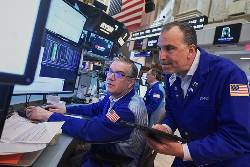
Markets on Wall Street were mixed in early trading Tuesday and oil prices soared as diplomatic efforts to end the Iran war appeared destined to stall again.
Futures for the S&P 500 slipped 0.6% while futures for the Dow Jones Industrial Average gained 0.2%. Nasdaq futures sank 1.1%.
The Trump administration seemed unlikely to accept Iran’s offer to end the war and reopen the Strait of Hormuz on the condition that the U.S. lifts its blockade on the country's ports.
The proposal would postpone discussions on the Islamic Republic’s nuclear program, something that U.S. Secretary of State Marco Rubio appeared to rule out in a TV interview Monday. The White House said U.S. President Donald Trump’s national security team discussed the offer and Trump would address it later.
The lack of progress to end the Middle East conflict has kept oil and gas prices elevated in recent months.
The price for a barrel of Brent crude to be delivered in July, the most heavily traded futures contract, rose $3.26 to $104.95 per barrel.
Brent prices were at about $70 per barrel before the war and have briefly shot to nearly $120. Benchmark U.S. crude for delivery in July added $4.47 to $100.84 a barrel. Meanwhile, the average price of for a gallon of gasoline in the U.S. reached $4.18 on Tuesday, the most since 2022, according to the auto club AAA.
Rising oil prices have lifted energy companies since the onset of the Iran war in late February. On Tuesday, British energy giant BP reported that its profit more than doubled from a year ago, sending its shares up 3.2%.
American oil companies ExxonMobil, ConocoPhillips and Chevron all rose between more than 2% in premarket. All three of those companies report earnings this week.
The Federal Reserve meets on Wednesday to decide where to take interest rates. In light of the war in Iran and rising energy costs, most experts expect the Fed to stand pat, neither raising nor cutting its benchmark lending rate out of fear that it could exacerbate inflation.
Also Wednesday, the Senate Banking Committee will vote on whether to confirm Trump’s nominee, Kevin Warsh, to succeed Fed Chair Jerome Powell. The committee is expected to approve Warsh, sending his nomination to the full Senate.
In Asia, Japan's benchmark Nikkei 225 fell 1.0% to finish at 59,917.46 after the central bank opted to keep its key interest rate unchanged at 0.75%.
The Bank of Japan said that while the economy was still growing moderately it was expected to slow as the war pushes for crude oil and other products higher. The vote by its monetary policy board at 6-3 was not unanimous. Pressures have been growing for Japan to gradually raise interest rates after keeping them near or below zero for years to combat deflation.
“There are various risks to the outlook," it said in a statement. “For the time being it is necessary to pay particular attention to the impact of the future course of the situation in the Middle East.”
Elsewhere in Asia, South Korea's Kospi edged up 0.4% to 6,641.02.
Hong Kong's Hang Seng dipped nearly 1.0% to 25,679.78, while the Shanghai Composite shed 0.2% to 4,078.64.
Australia’s S&P/ASX 200 lost 0.6% to 8,710.70.
In Europe at midday, France’s CAC 40 fell 0.3%, while the German DAX lost 0.4%. Britain’s FTSE 100 was virtually unchanged.
___
Yuri Kageyama is on Threads: https://www.threads.com/@yurikageyama
... Copyright © 1996 - 2026 CoreComm Internet Services, Inc. All Rights Reserved. | View our