

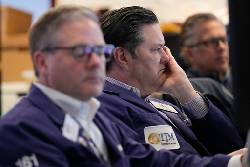
NEW YORK (AP) — Oil prices are back above $100 per barrel on Monday after 21 hours of ceasefire talks failed to end the U.S.-Iran war. But U.S. stocks are nevertheless holding steady in an indication that Wall Street still sees a chance for both sides to avoid a worst-case scenario for the global economy.
The S&P 500 was virtually unchanged in midday trading after erasing an earlier dip. The Dow Jones Industrial Average was down 256 points, or 0.5%, as of 11:45 a.m. Eastern time, and the Nasdaq composite was 0.3% higher.
The oil market showed more concern, and prices there rose more than 6%. But even there, prices pared bigger, earlier gains as the morning progressed. The moves are much more modest overall than the extreme swings that have hit financial markets since the war began in late February.
After this past weekend’s talks failed, President Donald Trump announced a blockade of the Strait of Hormuz, a move that raises the pressure on Iran by trying to prevent it from making money by selling oil.
A blockade would keep even more oil off the global market, after prices already jumped for everyone worldwide because of Iran’s restrictions on traffic in the important strait. That narrow waterway is how much of the oil produced in the Persian Gulf area reaches customers worldwide.
Iran responded by threatening all ports in the Persian Gulf and the Gulf of Oman.
“Security in the Persian Gulf and the Sea of Oman is either for everyone or for NO ONE,” the Islamic Republic of Iran Broadcasting reported Monday. “NO PORT in the region will be safe,” according to a statement from the Iranian military and the Revolutionary Guards.
The price of Brent crude, the international standard, rose back to $101.90 per barrel and is well above its roughly $70 price from before the war. But it remains below the $119 peak it’s touched at times, when worries about the U.S.-Iran war have been at their heights. It also pulled back from its nearly $104 price reached earlier Monday morning.
“Markets are taking some encouragement from the fact that the two sides are talking and that the broader ceasefire seems to be holding, for now,” according to Sameer Samana, head of global equities and real assets at Wells Fargo Investment Institute.
In the meantime, big U.S. companies are beginning to tell investors how much money they made during the first three months of the year. Strong reports could help make up for worries about the Strait of Hormuz on Wall Street because stock prices tend to follow the trend of corporate profits over the long term.
Goldman Sachs, the investment bank, said it made $5.63 billion in profit during the quarter, more than investors expected. But financial analysts pointed to some potentially concerning signals underneath the surface, including lower revenue from the trading of fixed income, commodities and currencies. Its stock fell 3.4%.
Big banks traditionally lead earnings reporting season each quarter, and Citigroup, JPMorgan Chase, Wells Fargo, and Bank of America will all report later this week. So will Johnson & Johnson, Netflix and PepsiCo.
Helping to lead Wall Street was Sandisk, which jumped 6.5% after learning it will replace Atlassian Corporation in the Nasdaq 100 index before trading begins on April 20. It will get included in such funds that track the index as Invesco's QQQ, which controls nearly $395 billion in investments.
Oil-and-gas companies were also relatively strong as crude prices rose. Halliburton gained 1.9%, and ConocoPhillips climbed 1.1%.
In the bond market, Treasury yields ticked higher. The yield on the 10-year Treasury rose to 4.33% from 4.31% late Friday.
Yields have been on the rise since the war began because of worries about high oil prices and inflation. That in turn has sent up rates for mortgages, which has hurt the housing market. A report on Monday said that sales of previously occupied homes were weaker in March than economists expected.
In stock markets abroad, indexes fell across much of Europe and Asia. Hong Kong’s Hang Seng fell 0.9%, and South Korea's Kospi dropped 0.9% for two of the world’s larger losses.
“The outcome of the talks was not really what people were hoping for, that’s for certain,” Neil Newman, Managing Director, Head of Strategy at Astris Advisory Japan, said in Hong Kong about the U.S.-Iran negotiations.
“As we stand here at the moment, it doesn’t look very nice. Certainly, the oil prices are a big concern.”
___
AP journalists Yuri Kageyama, Matt Ott and Mayuko Ono contributed to this report.
... Copyright © 1996 - 2026 CoreComm Internet Services, Inc. All Rights Reserved. | View our