

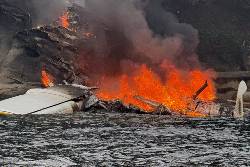
SEATTLE (AP) — The pilot of a float plane that crashed on a remote island near Washington's border with Canada, injuring all 11 people on board, changed course to avoid a thunderstorm before it went down, the company that operated the flight said Friday. But it remained unclear what caused the crash.
The Kenmore Air seaplane struck a rocky shore along Sucia Island, a state park north of the main San Juan Islands, on Thursday evening after veering past sailboats and other vessels. A swift rescue by nearby boats and a helicopter got everyone safely to hospitals.
As of Friday afternoon, three passengers remained hospitalized, all in satisfactory condition. The pilot was among those released. The San Juan County Sheriff’s Office said the people had head injuries, broken bones and cuts.
The crash came less than three weeks after a seaplane carrying eight people made a rough landing in New York City’s East River, causing minor injuries.
Videos posted on social media showed the aircraft turning to one side as it flies low over the water near several boats and the shore. The plane makes a hard landing, at first touching down on just one float, then briefly skips into the air before hitting land.
The San Juans are a rugged archipelago between Washington and British Columbia. They are a popular summer vacation spot known for ferries, whale watching and hiking.
First responders and witnesses race to the scene
Dave Eastman was in a dinghy on the water when the plane approached. At first he was worried it was going to hit his boat, he said, but then he saw it flying low toward the island. There were six or seven boats in the area and everyone raced to help, he said.
In the videos, passengers can be seen exiting the plane as black smoke rises. Soon bright orange flames engulf the fuselage, which came to rest partially submerged against a large rock.
“It kind of just shook us up a little bit,” he said. “Knowing everyone’s OK, at least that everyone is alive at this point, that kind of helps ease the concern.”
Eastman, of Lynnwood, Washington, said Thursday started off with nice weather, but a lightning storm hit the area around the time of the crash. Heavy rain began falling as the plane was burning, he said.
Several agencies scrambled to respond. The U.S. Coast Guard sent a helicopter while their Canadian counterparts mobilized a hovercraft, according to a recording of San Juan County dispatch audio posted by Broadcastify.
A video released by the U.S. Coast Guard showed a person being hoisted from a vessel below into an MH-65 Dolphin helicopter, his right leg immobilized in a splint.
Sucia Island features a maze of coves, beaches and rocky points. The plane went down near Shallow Bay, which cuts a wide crescent into the island near a campground.
The same type of seaplane crashed near Seattle in 2022
The plane's operator said it was a DHC-3 Otter made by de Havilland Aircraft of Canada. That is the same model of floatplane as one that plunged into the waters of Puget Sound northwest of Seattle in 2022, killing 10 people.
Federal regulators ordered seaplanes to be inspected afterward, and investigators found a single component of a critical flight control system had failed.
The plane that crashed Thursday was operated by Kenmore Air, a tourism airline based near Seattle, which is a different company than the one involved in the 2022 crash. Founded in 1946, Kenmore Air bills itself as the largest seaplane operator in the U.S.
The Otter is a workhorse seaplane model that has been used widely for decades, said aviation safety expert John Cox.
The cause of the crash will be investigated
The National Transportation Safety Board may be able to quickly get an idea of what happened because investigators will be able to interview the pilot and witnesses and watch videos of the crash, Cox said.
The wreckage was recovered and placed on a barge by Friday afternoon. The agency will publish a preliminary report in about a month.
In a statement, the airline said it would not speculate about why the plane went down. According to the flight tracking website Flightradar24, the seaplane made an abrupt 180-degree turn about three minutes before the crash, heading back toward Sucia Island, which it had just passed on its path west.
“There was a weather system in the area at the time, and the pilot adjusted the flight path in response to that weather,” Kenmore Air said.
The plane was up to date on its maintenance, with its last 100-hour inspection completed June 25, the airline said.
“We are grateful that everyone aboard has been accounted for,” Kenmore CEO David Gudgel said. He said the company canceled all scheduled flights for Friday and was cooperating with investigators.
The aircraft took off from Lake Union in Seattle, which is about 80 miles (130 kilometers) south of Sucia Island, and was headed to Roche Harbor, the site of a historic hotel, marina and resort on San Juan Island.
___
McCormack reported from Concord, New Hampshire, and Collins reported from Hartford, Connecticut. Associated Press transportation reporter Josh Funk in Omaha, Nebraska, contributed.
... Copyright © 1996 - 2026 CoreComm Internet Services, Inc. All Rights Reserved. | View our