

VIENNA (AP) — Inspectors with the U.N. nuclear watchdog visited several sites in Syria in August and carried out verification work, according to a confidential report circulated to member states and seen Tuesday by The Associated Press.
Based on this visit, the International Atomic Energy Agency reported that it is "able to establish that the former Syrian authorities had failed to report nuclear material, facilities and activities as required under the NPT Safeguards Agreement."
This information included a nuclear reactor under construction in Deir el-Zour, a fuel fabrication plant and another site used for fuel storage during the rule of former President Bashar Assad.
Under Assad, Syria was believed to have operated an extensive undeclared nuclear program that included a nuclear reactor built by North Korea in eastern Deir el-Zour province.
The site in Deir el-Zour only became public knowledge after Israel launched airstrikes in 2007 that destroyed the facility. Syria later leveled the site and never responded fully to the IAEA’s questions about it.
The IAEA took samples at the site in 2024 and reported last year that they contained uranium particles.
The IAEA reported on Tuesday that its inspectors visited the Deir el-Zour site on Aug. 29 “to monitor progress on the excavation work.”
“Based on observations made at the location, the Agency confirms that the cooling infrastructure which has now been uncovered is consistent with that of a nuclear reactor.”
In its confidential report on Tuesday, the IAEA said that three locations were “functionally related” to the Deir el-Zour site. One was related to “conversion and/or fuel fabrication activities,” another was for “temporary storage of construction material,” and another was for the “temporary storage of construction materials being transferred to/from” the site, as well as for “planned reprocessing activities.”
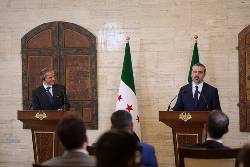
During the visit to Syria, IAEA Director General Rafael Grossi and a team of senior inspectors also visited a previously undeclared site in the country.
Syria notified the agency of the site’s existence in a July 17 letter and invited the IAEA “to cooperate with the Syrian authorities in the inspection and verification of the site and of any nuclear material to be potentially found.”
The IAEA said in its report that this new site contained “natural uranium metal in the form of fuel rods with cladding.” The agency verified the material and confirmed “the presence of around 73 tonnes of natural uranium metal.” The agency reported that “all of this nuclear material is currently subject to Agency containment and surveillance measures.”
___
The Associated Press receives financial support from multiple private foundations. AP is solely responsible for all content. Find AP’s standards for working with philanthropies, a list of supporters and funded coverage areas at AP.org.
... Copyright © 1996 - 2026 CoreComm Internet Services, Inc. All Rights Reserved. | View our