

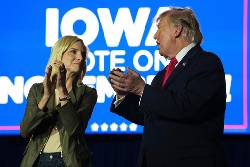
WASHINGTON (AP) — President Donald Trump has repeatedly encouraged voters to pretend he's on the ballot this Election Day. He's not, of course. But there is reason to believe that Tuesday's midterms, above all, will be a referendum on his performance over the last two years.
History, polling and early voting numbers suggest it could be a difficult night for Trump's Republican Party, though the political map, not to mention a fresh round of gerrymandering, could limit Democratic gains.
Voters are in the mood for change, according to the AP Voter Poll, which found that roughly three-quarters of voters say they feel “angry” or “dissatisfied” with the way things are going in the country today. Most appear to blame the Trump administration for high costs. About 6 in 10 say higher than usual prices are “more because of Trump’s policies” rather than “more because of factors outside Trump’s control.”
Additionally, about 70% of voters want Congress to provide more checks and balances on the presidency.
Democrats are looking to win majorities in the House and Senate, which would curb Trump's power after he's faced few limits from a compliant Republican-controlled Congress. Several key governors’ offices also are up for grabs.
More than 59 million Americans already had voted before Tuesday, but many more ballots will be cast on Election Day, and government watchdog groups worry that Trump and his loyalists could interfere with the voting process. Fearing a worst-case scenario, Democrats and nonpartisan watchdogs have trained tens of thousands of volunteers to monitor polling places.
Here's what we're watching Tuesday:
Trump said: ‘Pretend I'm on the ballot.' What do voters say?
The Republican president is trying to defy history, which shows that in almost every modern midterm election the party in the White House has lost seats in Congress — sometimes many of them.
Democrats certainly hope that's the case this year. The party is optimistic, given Trump's dismal approval ratings and voter concerns about the war with Iran and the surging price of gas and other daily necessities.
The AP Voter Poll, an expansive survey of the electorate, suggests most are deeply unhappy with Trump, with roughly 6 in 10 saying they disapprove of how he’s handling the presidency.
About 4 in 10 say the economy is the most important issue facing the country, while 3 in 10 say the most important issue is democracy, according to the poll, well above the number who said the same about crime, healthcare and immigration.
Trump is betting that his base of white working-class voters, which fueled his presidential victories in 2016 and 2024, can save his Republican allies if they show up in great numbers. Heading into Election Day, however, there are signs that Democrats are more fired up to vote against him and his party.
We're about to learn whether Trump and his coalition are still strong enough to stave off a political beatdown. Specifically, look to see whether Hispanic and Black voters and younger people who swung toward Trump two years ago now rebuke him.
The answer will have huge implications in the midterms and the next presidential cycle.
Can Democrats win both chambers of Congress?
It doesn't happen often.
Since World War II, the House and Senate have flipped from one party to the other in the same midterm just three times: 1946, 1994 and 2006. The common thread when it does happen is an electorate clamoring for change or broad frustration with the sitting president.
This year has both, and Democrats are trying to capitalize on the opportunity.
Strategists in both parties believe Democrats are on track to win a majority in the House, where Republicans began the current Congress with a slim margin of 220-215.
It's unclear how big of a swing there could be, however. Democrats are targeting more than 60 districts, including many where Trump won by double digits. But between redistricting and the deep partisan divide between metropolitan and rural America, there simply aren't as many competitive races as there were in some previous years when the House flipped, including 2018, when Democrats netted 40 more seats.
Early tells could be Pennsylvania's 1st District, where Republican Rep. Brian Fitzpatrick is trying to hold his suburban Philadelphia seat; Florida's redrawn 22nd and 25th Districts, both of which were supposed to be Republican pickups after redistricting this spring; Virginia's 2nd District rematch between Republican Rep. Jen Kiggans and Democratic former Rep. Elaine Luria; and Virginia's 1st District, where Democrat Shannon Taylor, a local prosecutor, is challenging Republican Rep. Rob Wittman.
The Senate, meanwhile, is up for grabs. Republicans currently have a 53-47 advantage. To net the four seats that Democrats need to take control, they must win states that Trump won. Among their targets: Ohio, Iowa, Kansas, Texas and Alaska.
Early East Coast results could offer clues. Democrat Roy Cooper is favored to flip an open North Carolina seat, and Democratic Sen. Jon Ossoff is widely expected to win reelection in Georgia. If one or both of those outcomes don't happen, or if the margins are razor-thin, it could forecast a stronger-than-expected Republican performance elsewhere.
Will Trump interfere?
It's a question not usually asked in U.S. politics.
The world is watching to see whether the president leverages the vast resources of the federal government to interfere with the election. Based on recent rhetoric, legal action and his yearslong record of promoting baseless claims of widespread voter fraud in elections he loses, there is reason to take the threat seriously.
In recent days, the Trump administration hinted at federal intervention in Alaska after a judge rejected his Justice Department's lawsuit seeking to block certification of the Senate race if Republican Sen. Dan Sullivan loses. Trump called the situation "voter fraud at the highest level.” The administration also tried and failed to block California from counting 20,000 ballots from people the federal government has identified as “likely” noncitizens.
Trump’s Department of Justice is sending about 1,000 department staff to observe voting and ensure federal laws are being followed. Election observers are more concerned that Trump may dispatch federal immigration agents or the National Guard to intimidate voters in large Democratic precincts.
The Trump administration says it has no current plans to do so.
Still, a vast election protection effort will be on display this week featuring hundreds of Democratic groups and government watchdogs.
What version of the Democratic Party will emerge?
While Trump's standing has cratered in 2026, Democrats' brand as a whole isn't much to brag about. That will leave the party's major factions — the progressive left flank and the liberal-to-moderate establishment — parsing the outcomes to claim any advantage in Democrats' tug-of-war over party identity.
Michigan Democratic Senate nominee Abdul El-Sayed is progressives' highest-profile candidate, and the movement would have a feather in its cap should he defeat Republican Mike Rogers to keep the seat in Democrats' hands. It's one thing for New Yorkers to elect Zohran Mamdani, a democratic socialist, as mayor. It's quite another for an unabashed progressive like El-Sayed to carry a perennial battleground state that helped elect Trump twice.
On the other hand, progressives could lose leverage if their candidates are unsuccessful. Senate losses in Michigan and Minnesota — where Lt. Gov. Peggy Flanagan is defending a Democratic-held open seat against Republican Michele Tafoya — could cost Democrats control of the Senate and lead to serious finger pointing.
Still another possibility is that Democrats of all ideological stripes win, piling up Senate, House and gubernatorial victories that depend on urban, suburban and rural voters. That scenario would do little to resolve the discussion over party identity and would all but guarantee a wide-open, rollicking presidential nominating fight.
What effect will
Trump's gerrymandering push have?
Trump set off a tempest in Texas last year when he pushed the most populous Republican-run state to redraw congressional boundaries. California Gov. Gavin Newsom answered by persuading his state's voters to respond in kind. Democratic and Republican states followed. Along the way, the U.S. Supreme Court gutted part of the Voting Rights Act, thus allowing several Southern states to redraw districts that had been majority or near-majority Black.
On paper, the results suggest a net shift of nine seats to Republicans. But the gerrymandering meant spreading conservative supporters across more districts. In Florida and Texas, especially, the Republican plan counted on getting help from Latinos and other nonwhite voters who backed Trump in 2024 — and that may not happen.
Tuesday's results will settle whether redistricting ends up being a clear Republican benefit or a reminder that the law of unintended consequences can apply in politics, too.
... Copyright © 1996 - 2026 CoreComm Internet Services, Inc. All Rights Reserved. | View our