

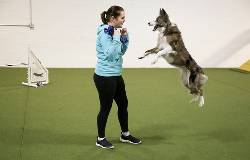
NEW YORK (AP) — A crowd is waiting to see you run a labyrinthine obstacle course you have never done before. You have to complete it with enough focus to avoid wrong turns, enough precision to ensure your foot touches certain spots and enough speed to beat dozens of rivals.
Also: You are a dog.
Specifically, you are one of the canine aces in Saturday's Westminster Kennel Club agility competition, a recent addition that kicks off the storied club's milestone 150th dog show.
So how do you do it?
“It's training and connecting. And it's just the most wonderful sport ever,” handler Pam Vojtas said Saturday before a run with her Pyrenean shepherd, Madeleine. “She reads my mind.”
Or, as last year's Westminster-winning handler, Emily Klarman, put it in a recent interview, “Agility is a big conversation that we’re having with our dogs.”
The conversation is partly verbal, with handlers yelling such commands as “tunnel!” and “jump!” and dogs sometimes answering with barks of enthusiasm. But communication also happens as handlers place their bodies purposefully, aware that dogs can draw cues from their eyes and even the angle of their knees, and they interpret the animals’ own body language to keep them on target.
“If they're looking at something, that's probably what they're thinking about,” Klarman said before a recent practice session with Swish, a border collie, at the UDog training center in Huntingdon Valley, Pennsylvania.
The breed with the most wins
Like a furry rocket, the lean, mottled, 5-year-old navigated jumps, close-set poles, tight turns, narrow ramps, a seesaw and other equipment as though it was in her DNA. To some extent, it is — border collies are renowned for their intelligence, intensity and nimbleness, and they have taken Westminster's agility title in nine of its 12 years so far. Klarman and her dog Vanish notched one of those winning runs; three others were piloted by UDog's founders, Jessica Ajoux and Perry DeWitt.
But regardless of breed, becoming an agility champion takes a lot of training, technique and strategy.
Scores are based on both accuracy and time, and the canines get penalty points if, for example, they bound off seesaws and ramps too soon. They have to set foot in the end section. To instill that habit, a handler might get the dog accustomed to walking onto a pad on the ground, then put that pad on the end of the obstacle and eventually remove the pad.
Dogs also must master different approaches to jumps, depending on whether they need to turn tightly after landing.
Agility trials don’t allow for leashes, treats or toys on the course, so dogs need to be motivated by the fun of the game and their relationship with their handlers. And, perhaps, the prospect of a reward afterward. Georgie, a golden retriever, gets a toy stuffed with steak, meatballs or hot dogs, handler Cindy McGovern said while awaiting a run Saturday.
While dogs learn signals, handlers need to memorize complex pathways through 20 obstacles. At Westminster, they don't get maps until the morning of the competition, then have a few minutes to walk the course and ponder, for instance, whether to cross ahead of or behind the dog on various turns.
“It's all about giving them the information they need,” handler Lee Ann Donner said between runs with her whippet, Gus.
Besides the mental and physical work, there's emotional training. The animals “can definitely tell whether we're really excited and pumped up, or we're disappointed,” explains Klarman, who was careful not to let her feelings show when Vanish didn’t excel on a seesaw obstacle in the Westminster finals last year.
What agility added to the Westminster show
Westminster, considered the United States’ most illustrious dog show, added an agility competition in 2014. The popular canine sport introduced a faster-paced, more athletic and more all-embracing flavor to the traditional, buttoned-up parading of purebred dogs around rings. Agility is open to mixed-breed dogs, and a mix won in 2024.
A dog fan since she was a toddler, Klarman got into canine sports as a preteen, then got a nursing degree before realizing that she wanted to work with dogs as a career. Last year's Westminster win was a capstone.
“It really meant so much to showcase her and let the world know how special she is,” recalls Klarman.
This year, she was cheering for her boyfriend, Peter Wirth, and his Pembroke Welsh corgi, named Welly.
Like a number of agility handlers, Wirth, 34, took up the sport simply because he had a very energetic dog that needed more stimulating activity than walks and fetch. Five years later, he and Welly returned to New York's Javits Center on Saturday for the Westminster contest.
Klarman and Vanish stayed home, for a good reason. The dog's first litter of puppies is due any minute.
... Copyright © 1996 - 2026 CoreComm Internet Services, Inc. All Rights Reserved. | View our