

Iran on Thursday dismissed U.S. President Donald Trump’ s threats of economic pain and isolation, while the U.K and other nations condemned Israel over a controversial settlement project.
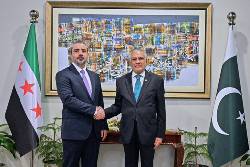
Meanwhile, Syria’s foreign minister visited Pakistan, which is seeking to defuse tensions between the United States and Iran.
Here’s a look at the latest developments in the Iran war and the wider Middle East on Thursday. Full coverage can be found here.
Iran denounces Trump's economic threat
Iran’s Foreign Minister Abbas Araghchi has rejected the economic threats made against his country, saying that such “failed policies” will stir more hostility among Iranians and “bring more failures.”
Araghchi's comments came a few hours after President Donald Trump threatened “crushing economic measures” against Iran. Trump promised “Economic Warfare and Isolation on an unprecedented scale,” but provided few details.
In a social media post, Araghchi maintained the threats aim to divert the attention of the U.S. public from domestic financial problems, adding that the U.S. “economic terrorism threatens the global economy and the national sovereignty of countries around the world.”
Planned West Bank settlement project draws rebuke from UK and others
Several countries condemned the latest development in a contentious Israeli settlement project near Jerusalem that would effectively cut the occupied West Bank in two.
Israel’s Ministry of Construction and Housing issued a tender for constructing several compounds with more than 1,200 homes in total in an open tract of land east of Jerusalem. It’s the latest step in a project under consideration for more than two decades, which critics say would prevent the establishment of a contiguous Palestinian state in the territory.
British Foreign Secretary Ed Miliband called the publication of the tender “an unacceptable and destructive act” and denounced “settler violence and terrorism.” In a statement released on Wednesday, he added that the British government “demanded an immediate reversal” and had summoned the Israeli Chargé d’Affaires.
Egypt and Jordan also condemned Israel’s move, which Cairo said would isolate east Jerusalem from its Palestinian surroundings.
Israeli Foreign Minister Gideon Saar responded on Thursday by defending “the historic right of the Jewish people to reestablish their national home in the Land of Israel — including in the area in question.” Saar criticized Britain’s government for “blaming only Israel while ignoring Palestinian extremism.”
Turkey denies delegation had visited air base in Syria that was hit by Israel
Turkey has denied that a Turkish military delegation had visited an air base in northern Syria that was hit by Israeli airstrikes, and vowed to continue supporting Syria in its efforts to rebuild its military.
The Israeli strikes targeted the Abu Duhur base early on Tuesday, causing damage but no casualties. Israeli Prime Minister Benjamin Netanyahu’s office said Israel had attacked the base because Syria was “on the verge of breaching” an agreed-upon “status quo in security matters” by allowing Turkish troops to deploy there.
Syrian officials have said that a Turkish delegation visited the base before the Israeli strike to review rehabilitation work underway there.
“We state that no Turkish military delegation was present at the base before or during Israel’s strike on the Abu al‑Zuhur air base,” Turkey's defense ministry said in a statement. It said Turkey would continue to support Syria’s infrastructure and military capacity-building efforts.
The attack drew condemnation from Turkey, Syria and a number of Arab countries.
Syria's top diplomat discusses Middle East in Pakistan
Syria's Foreign Minister Assad al-Shibani has arrived in Islamabad for talks expected to focus on regional issues, Pakistan's Ministry of Foreign Affairs said.
The visit comes days after Israeli airstrikes targeted an air base in northern Syria, causing damage but no casualties.
Pakistani officials say the country's political and military leadership remains in contact with both Iran and United States over efforts to de-escalate tensions and push for the resumption of talks after a 60-day deadline under a June memorandum of understanding expired. The agreement was brokered by Pakistan with help from regional countries.
Pakistani crew members killed in Houthi attack are repatriated
The bodies of two Pakistanis killed in last week’s Houthi attack on a Tanzanian-flagged commercial vessel in the Bab el-Mandeb Strait have been repatriated to Pakistan.
Six Pakistani sailors who were injured in the attack have also safely returned to the country, Foreign Minister Ishaq Dar said in a post on X.
Dar thanked Saudi Arabia’s Foreign Ministry for its cooperation, including medical assistance.
“Pakistan condemns the attack in the strongest terms and reiterates that the safety and security of seafarers must be ensured at all times,” Dar said.
Oman reaffirms commitment to maritime security
An Omani official said that ensuring safe passage through the Strait of Hormuz is “inseparable from the security and prosperity of the wider region.”
Speaking at a press briefing alongside his Japanese counterpart, Omani Foreign Minister Badr al‑Busaidi said lasting security in the strait requires “lasting peace in the region,” which can only be achieved through restraint and sustained diplomacy.
Earlier in the week, Iran announced it had reached an understanding with Oman on a framework for ship transit through the strait, which run between the two countries, and that both sides are working to finalize the details for a joint statement.
Shipping has been disrupted and the strait has been virtually closed since the Iran war started on Feb. 28. Before the war, which began with U.S. and Israeli strikes on Iran, about one-fifth of the world’s traded oil and natural gas passed through the waterway at the mouth of the Persian Gulf.
... Copyright © 1996 - 2026 CoreComm Internet Services, Inc. All Rights Reserved. | View our