

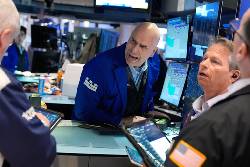
Wall Street hovered around yesterday's levels and oil prices barely budged early Friday amid a shaky ceasefire agreement between the U.S. and Iran, which maintained its stranglehold on the Strait of Hormuz.
Futures for the S&P 500 were flat before the opening bell, while futures for the Dow Jones Industrial Average inched down less than 0.1%. Nasdaq futures gained less than 0.1%.
Iran’s semiofficial Tasnim news agency, close to the Revolutionary Guard, claimed that talks set for Saturday wouldn’t happen unless Israel stopped its attacks in Lebanon. U.S. President Donald Trump complained that Iran was “doing a very poor job” by not allowing the free flow of ships through the strait, through which 20% of the world’s traded oil once passed.
Ahead of the Saturday's talks, deadly Israeli strikes on Lebanon raised questions whether the two-week ceasefire in the Iran war is still intact, while the Islamic Republic maintained control over the Strait of Hormuz, which is largely closed despite demands from the U.S. to reopen the waterway critical for global oil and gas transport.
Israeli Prime Minister Benjamin Netanyahu said he had authorized talks with Lebanon, with negotiations said to be expected in Washington next week.
Oil prices inched up modestly on early Friday. Brent crude, the international standard, was up 12 cents at $96.04 per barrel. Benchmark U.S. crude ticked up 33 cents to $98.20 a barrel.
For oil prices, “$65-70 a barrel is not coming back,” Ajay Rajadhyaksha of Barclays wrote in a recent research note, referring to the pre-Iran war oil price levels. The bank predicts that Brent crude could remain at around $85 per barrel on average for this year.
“A ceasefire is not a refund,” he wrote. “Ceasefires end wars; they don’t undo them.”
Coming later Friday morning is the government's latest report on prices at the consumer level. Several measures of inflation remain far enough above the central bank's 2% target that few expect Fed officials to cut interest rates anytime soon, especially considering the economic uncertainty brought on by the conflict in the Middle East.
At midday in Europe, Britain's FTSE 100 was up 0.4%, while France's CAC 40 and Germany's DAX each gained 0.7%.
Asian stocks ended mostly higher Friday. South Korea’s Kospi climbed 1.4% to 5,858.87. Tokyo’s Nikkei 225 jumped 1.8% to 56,924.11. Shares of Fast Retailing, parent of Japanese clothing retailer Uniqlo, surged 12% after the group raised profit expectations for the year.
Hong Kong’s Hang Seng gained 0.6% to 25,893.54, while the Shanghai Composite index was 0.5% higher at 3,986.22. China on Friday reported that its consumer price index — a main inflation gauge — was up 1% in March compared with a year ago, lower than what analysts had expected and down from the 1.3% increase in February.
Australia’s S&P/ASX 200 lost 0.1%, while Taiwan’s Taiex rose 1.6%.
... Copyright © 1996 - 2026 CoreComm Internet Services, Inc. All Rights Reserved. | View our