

WASHINGTON (AP) — The American Dream may not be dead for many Black Americans, but it is further away than at any point since the Civil Rights Movement, warns a report by the National Urban League.
Released on Thursday, the annual “State of Black America” report grimly describes Black Americans ' economic and political prospects as having worsened due to policy changes from President Donald Trump's administration, according to a copy obtained by The Associated Press.
The report contends that the challenges it highlights for Black communities are warning signs for the prosperity of all Americans.
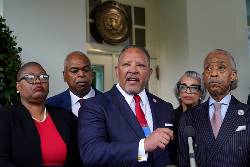
“It may be the focus is us, but the impact is not just us,” said Marc Morial, president and CEO of the National Urban League. “While they have targeted and focused on Black Americans, these attacks are going to impact broadly working Americans, poor Americans, aspirational middle-class Americans, and this is what this report points to.”
Tracing the arc of American history, the Urban League describes Black Americans' struggle for emancipation from slavery and equal economic and political rights as a gruesome but optimistic part of the American story.
Now, the report says, the Trump administration is at odds with the goals and achievements of the Civil Rights Movement, citing the overhaul of the Justice Department’s Civil Rights Division and the Equal Employment Opportunity Commission, as well as the president’s focus on overhauling voting laws through the Safeguard American Voter Eligibility Act, as examples of rollbacks of long-sought civil rights policies.
The report's authors offer policy and strategy recommendations for civil rights groups aiming to combat the Trump administration.
“The civil rights community must consolidate its legal resistance and turn courtroom wins into durable policy,” the report says. “The movement must build economic infrastructure that doesn’t depend on the goodwill of any one administration.”
Report contributors include potential Democratic presidential contender
This year’s report includes contributions from members of Congress, and policy and legal experts, as well as some media personalities.
U.S. Senators Angela Alsobrooks, Lisa Blunt Rochester and Raphael Warnock all contributed to the report, as well as Maryland Gov. Wes Moore and Baltimore Mayor Brandon Scott. Minneapolis Mayor Jacob Frey contributed a video message to the report.
Moore, who is widely viewed as a potential 2028 presidential contender, submitted an essay focused on closing the racial wealth gap and Black Americans' history of economic advancement in the face of adversity.
“With wisdom and grit, my mom was able to lift me and my family to a higher rung on the economic ladder. But too often wisdom and grit aren't enough,” Moore wrote.
He later called closing the racial wealth gap “a matter of moral clarity” but cautioned that “government alone cannot close the racial wealth gap. It's going to take all of us,” referencing the private sector and civil society.
Report blasts 'economic assault' on Black Americans
Whether corporate America and major nonprofits are still willing to participate is an open question. The report condemns the Trump administration’s efforts to roll back diversity initiatives and economic advancement projects in the private sector, and expressed frustration with companies that cooperated with an “economic assault" on Americans, especially Black Americans.
“This has been a campaign of coercion and oppression directed at these institutions who have been out here working hard to, if you will, change America,” Morial said. “The important thing about companies is that every company has not bent the knee. Some may have done some cosmetic changes. Some have been in full and complete retreat.”
The DEI rollbacks are a jarring reversal for the Urban League, which held sway in the Biden White House on economic and social policies. The report lauds President Joe Biden's administration for signing a sweeping COVID-19 stimulus package, as well as laws supporting minority small businesses and a bipartisan infrastructure bill.
“Not every promise was kept, and the current administration is pushing to roll our wins back, but these wins serve as a blueprint for what is possible through sustained advocacy and a clear vision,” the authors write. The agenda, the Urban League declares, was “the most consequential federal investments in Black America since the Great Society.”
The organization and its civil rights allies now find themselves in a strikingly different political environment under the Trump administration.
“Looking at our current political landscape, the calls for racial healing and righting of this nation’s wrongs in the aftermath of the murder of George Floyd feel like a fever dream,” the report reads.
But the study also acknowledges that Black Americans have overcome more dire and discriminatory moments.
Latest Black America report is Urban League's 50th edition
The Urban League's inaugural 1976 report on the state of Black America was described by the New York Times at the time as “a profoundly depressing document” that laid out the persistent disparities between the economic outlooks of Black and white Americans, a decade after the Civil Rights Movement's crowning achievements were signed into law.
The report was established as a response to that year's State of the Union address by President Gerald R. Ford and the Democratic response, neither of which mentioned the economic outlooks for Black Americans. The report offered policy recommendations on crime, education housing, social services and general economic policy.
“It is a document that does not attempt to cover up the seriousness of the situation black people find themselves in,” the authors wrote at the time. Several of its recommendations were later taken up by President Jimmy Carter, who was elected to the White House months after the report’s release.
This year's 50th anniversary document echoes the frustration found in the inaugural report. While Morial acknowledged that the Urban League's assessments may lead to pessimism, he urged Americans concerned about civil rights and economic progress to respond at the ballot box and with their pocketbooks.
“We cannot be dejected. We cannot be cynical. We must act,” Morial said. “We have to fight to make sure that those that are really trying to kill the essence of the American dream don’t win.”
... Copyright © 1996 - 2026 CoreComm Internet Services, Inc. All Rights Reserved. | View our