

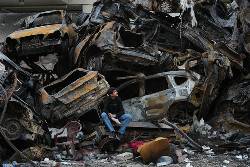
Lebanon and Israel were holding their first direct talks in decades as fighting between Israel and Hezbollah militants rocks southern Lebanon. U.S. Secretary of State Marco Rubio joined the Israeli and Lebanese ambassadors for Tuesday's discussions in Washington. Hezbollah says it will not abide by any agreement, a high-ranking member of the group's political council told the AP.
The U.S. military claimed Tuesday that it has successfully begun to enforce a blockade of Iranian ports, as the standoff between the U.S. and Iran deepens. Tehran threatened to strike targets across the region, a day after Trump warned on social media that any Iranian warships nearing the blockade would be destroyed in a “quick and brutal” strike.
With Pakistan racing to bring the sides together for more talks, U.S. President Donald Trump said Tuesday that a second round “could be happening over the next two days.” The first round ended without an agreement on Iran’s nuclear ambitions, which the White House says is a sticking point.
Neither side has indicated what will happen after the ceasefire expires on April 22.
Here is the latest:
UN chief says international law is ‘being trampled’ — especially in the Middle East
Secretary-General Antonio Guterres warned Tuesday that violations of international law are fueling instability and mistrust. Speaking to reporters at the U.N. headquarters, he urged renewed U.S.-Iran talks and respect for freedom of navigation in the Strait of Hormuz.
The secretary-general said he will travel to The Hague, Netherlands, later this week to mark the 80th anniversary of the International Court of Justice, the U.N.’s highest tribunal, and send “a message that in a world moving toward greater fragmentation and sharper power competition, international law is indispensable.”
US State Department issues $10 million reward for Iraqi militia leader
The bounty was placed on Ahmad al-Hamidawi, secretary general of the Iran-backed militia Kataib Hezbollah. In a post on X, in which it published al-Hamidawi’s photograph, the State Department’s Rewards for Justice program wrote that the group was “responsible for attacks on U.S. diplomatic facilities in Iraq, the kidnapping of U.S. citizens, and the killing of innocent Iraqi civilians.”
Last month, Kataib Hezbollah kidnapped an American journalist, Shelly Kittleson, in Baghdad, but released her several days later on condition that she leave the country. Officials with the group at the time told The Associated Press that in exchange, the Iraqi government would release several members of the militia who had been previously detained.
Kataib Hezbollah is allied with Lebanon’s Hezbollah but they are two entirely different groups with different leaders.
Trump says talks with Iran could resume this week
In a phone call with The New York Post, Trump said a second round of talks with Iran “could be happening over next two days.”
Trump initially told the newspaper they would likely be held somewhere in Europe but later updated that they could be held again in Pakistan’s capital.
An initial round of talks ended without an agreement on Iran’s nuclear ambitions, which the White House says is a central sticking point.
US military claims blockade success
The U.S. military claims that it has successfully begun to enforce a blockade of Iranian ports, though at least one ship with apparent ties to Tehran has transited the Strait of Hormuz.
U.S. Central Command, which oversees the Middle East, said that “during the first 24 hours, no ships made it past the U.S. blockade and 6 merchant vessels complied with direction from U.S. forces to turn around to re-enter an Iranian port on the Gulf of Oman.”
While some tankers approaching the strait on Monday did turn around shortly after the blockade took effect, the tanker Rich Starry reversed course again and transited the waterway early Tuesday.
Rubio says Israel-Lebanon talks are a process but doesn’t expect an immediate agreement
Secretary of State Marco Rubio says that historic Israel-Lebanon peace talks the U.S. is mediating are a “process, not an event,” downplaying expectations for any immediate or significant agreement.
Meeting at the State Department with the ambassadors of Israel and Lebanon to the United States, along with the U.S. ambassador to Lebanon, Rubio said the Trump administration is “very happy” to be facilitating the discussions.
“This is a historic opportunity,” he said. “We understand we’re working against decades of history and complexities” that will not be quickly resolved.
Israeli fire kills 5 Palestinians in Gaza, hospital officials say
Among the killed are a 3-year-old and a 15-year-old in the two separate strikes in northern Gaza and Gaza City on Tuesday, according to a health official at Shifa hospital, where the casualties arrived.
The Israeli military said it was looking into it.
The first strike on a police vehicle in Gaza City killed four, including the 3-year-old who was standing nearby, and another in the Jabaliya refugee camp in northern Gaza killed the 15-year-old, the hospital and the families said.
“What was this little kid’s fault? He was walking in the street,” said Samia al-Malahi, the grandmother of the 3-year-old.
The Gaza Strip has seen near-daily Israeli fire and strikes since a fragile ceasefire was reached in October, and more than 750 Palestinians have been killed since then, according to figures from the Hamas-run Gaza Health Ministry.
Turkey presses with diplomatic push for Iran-US talks
Turkish Foreign Minister Hakan Fidan has held separate telephone calls with his Iranian and Pakistani counterparts on Tuesday to discuss the negotiation process, a Turkish official said.
The conversation with Pakistani Foreign Minister Ishaq Dar centered “on the steps to be taken in the days ahead,” the official said.
The official, speaking on the condition of anonymity as required by protocol, did not provide further details.
— By Suzan Fraser
Death toll in Israel-Hezbollah war in Lebanon rises above 2,100
Israeli strikes have killed a total of 2,124 people during the six-week war, Lebanon’s health ministry said. Among them are 254 women, 168 children and 88 health workers. Another 6,921 have been wounded.
Israel has halted its strikes in Beirut since last Wednesday, when a massive barrage on the capital drew international outcry, but strikes and ground fighting have continued in the country’s south.
The war in Lebanon started on March 2, when the Iran-backed Lebanese militant group Hezbollah fired missiles across the border, two days after the U.S. and Israel launched their war on Iran.
UN chief praises Pakistan’s role in US-Iran talks
Pakistan’s Foreign Minister Ishaq Dar received a call Tuesday from U.N. Secretary-General António Guterres, who appreciated Pakistan’s “constructive role” in bringing the United States and Iran to the negotiating table to advance regional peace.
In a statement, the Ministry of Foreign Affairs said Dar reaffirmed Pakistan’s commitment to promoting dialogue and diplomacy to ensure peace and stability in the region.
Hezbollah appears to step up its fire on northern Israel as talks in Washington begin
The incoming fire triggered nonstop drone and rocket alert sirens in Israeli communities near the Lebanese border on Tuesday.
Ahead of the negotiations between Israel and Lebanon in Washington, the first direct talks between the two countries in decades, the Israeli military issued a warning to northern residents to be prepared for a possible increase of fire from Lebanon.
Hezbollah, which is opposed to the direct talks, claimed 26 attacks on northern Israel and on Israeli ground troops in southern Lebanon on Tuesday. It said it won’t stop its attacks until Israel halts its strikes on Lebanon.
China’s Xi warns against ‘the law of the jungle’
As the leaders of China and Spain pledged Tuesday to work to safeguard multilateralism at a time of conflicts including the war in Iran, President Xi Jinping reiterated a phrase he used earlier in the day when meeting the crown prince of Abu Dhabi — he said countries should “oppose the world’s retrogression to the law of the jungle.”
Xi said they should “jointly safeguard genuine multilateralism,” strengthen communication and cooperate closely, during a reception for Spanish Prime Minister Pedro Sánchez at the Great Hall of the People.
Sánchez agreed and said China and Spain “can contribute to finding solutions to the various trade tensions that exist, to the geopolitical difficulties and complexities of today’s world, to the wars, to the environmental and social challenges that afflict the world.”
▶ Read more:
Modi and Trump stress the need to keep the Strait of Hormuz open
Indian Prime Minister Narendra Modi and Trump spoke about the need to keep the Strait of Hormuz open during a call, Modi said on the social platform X.
Modi said the two leaders “discussed the situation” in the Middle East and “stressed the importance of keeping the Strait of Hormuz open and secure.”
The call between Modi and Trump lasted nearly 40 minutes, Indian media reported.
What Lebanon, Israel and Hezbollah said ahead of talks in Washington
Lebanon and Israel to hold first direct diplomatic talks in decades in Washington
The first direct diplomatic talks between Lebanon and Israel since 1993 are set to begin in Washington as fierce fighting continues between Israel and the Hezbollah militant group.
U.S. Secretary of State Marco Rubio will take part, along with Israeli Ambassador to the U.S. Yechiel Leiter and Lebanese Ambassador to the U.S. Nada Hamadeh Moawad.
Hezbollah is opposed to the direct talks, and will not be represented. Wafiq Safa, a high-ranking member of the militant group’s political council, told The Associated Press that it will not abide by any agreements made in the talks.
At least 2,089 people have been killed in Israeli strikes in Lebanon, the Health Ministry said, among them 252 women, 166 children and 88 medical workers, while 6,762 others were wounded. More than 1 million people are displaced.
▶ Read more
Treasury secretary says economic pain is ‘worth taking’ to end a nuclear Iran
As the Iran war drives up the cost of energy around the world, Bessent told a group reporters Tuesday that “a small bit of economic pain for a few weeks is worth taking off the incalculable tail risk of either a nuclear Iran or a nuclear Iran that uses that weapon.”
Asked about the impact of soaring gas prices on consumers, Bessent said “there is nothing more transient than what we are seeing now.”
“So the conflict will end, prices will come down, and then headline inflation will come down, and with that, gasoline prices will come down,” Bessent said.
US Treasury secretary says China ‘not going to be able to get their oil’
Scott Bessent was asked about Chinese tankers passing through the Strait of Hormuz after Iran recently demanded to collect tolls as a precondition for reopening the waterway.
“Those ships aren’t going to be allowed out anymore, ” Bessent told a group of reporters on the sidelines of the IMF World Bank meetings. “So they’re not going to be able to get their oil.”
When asked what his message to those paying the tolls would be: “You’re not going to pass,” Bessent said. And if a country pays the toll, “they are in violation of US sanctions, and that never ends well.”
Israel says 10 soldiers wounded in gunbattle with Hezbollah in the strategic Lebanese town of Bint Jbeil
The Israeli military said a “cell” of three Hezbollah militants fired on the troops, wounding 10, three of them severely. It said the soldiers returned fire, killing two of the militants, and the third was later killed by an airstrike.
Fighting has intensified in recent days between Israeli ground forces and Hezbollah militants in and around Bint Jbeil, with the army saying Monday it had killed over 100 Hezbollah fighters over the past week.
Bint Jbeil’s elevated location overlooking the UN-mandated Blue Line that divides Israel and Lebanon has made it a strategic point for Hezbollah. It was among dozens of villages and towns south of the Litani River that received an evacuation warning from the Israeli army early last month when the war started.
A president and a pope square off over Iran war
Pope Leo XIV, a studious and soft-spoken cleric, and Donald Trump, an unapologetically bellicose and pugilistic politician, have long been on a rhetorical collision course. Now their disagreement over the war in Iran has escalated in spectacular fashion.
On social media, Trump said Leo was “Weak” and captive to the “Radical Left,” even suggesting that Leo somehow owed his position to Trump.
The pope has declared Trump’s threats toward Iran “truly unacceptable” and pointed his flock to biblical text and church doctrine on war and peace, explaining that his purpose is not about Trump at all. “I’m not afraid of the Trump administration,” Leo said Monday on the way to Africa, “or of speaking out loudly about the message of the Gospel, which is what the Church works for.”
It’s a spectacle involving the world’s two biggest megaphones, both held by Americans for the first time.
▶ Read more about how they got to this point
Fuel protests have Ireland’s government facing possible no-confidence vote
Ireland ’s government could face a no-confidence vote Tuesday in Parliament over how it has handled a week of fuel protests that blocked access to oil supplies and a major port and caused massive traffic jams.
Prime Minister Micheál Martin announced new tax cuts to try to end the crisis that began after the U.S.-Israel war on Iran led to the closure of the Strait of Hormuz. But opposition parties blasted the government for failing to respond sooner and criticized the aid it offered, saying soaring fuel costs will drive people out of business.
Sinn Fein, the largest opposition party, called for the no-confidence vote scheduled Tuesday evening. But Martin’s coalition government has scheduled an earlier vote of support that could make the no-confidence motion moot.
▶ Read More
Pakistan’s prime minister briefs president on US-Iran talks, to visit Saudi Arabia and Turkey
Pakistan’s Prime Minister Shehbaz Sharif briefed President Asif Ali Zardari Tuesday on recent U.S.-Iran talks and said he will visit Saudi Arabia and Turkey this week to advance peace efforts. The announcement by the president’s office comes amid reports that Pakistan is seeking to host a second round of talks between Washington and Tehran in the coming days.
According to the statement, Zardari urged Sharif and other officials to remain engaged with the United States, Iran and other key regional and global powers to sustain the peace process and promote regional stability.
The statement said Zardari appreciates Pakistan’s role in facilitating rare direct talks between the United States and Iran, saying it had “reaffirmed its position as a responsible and pivotal state in the international community” and demonstrated its peacemaking credentials.
Italy suspends military partnership with Israel
Italian Premier Giorgia Meloni said Tuesday that her government has suspended the automatic renewal of a defense agreement with Israel, citing “the current situation.”
Meloni and other Italian government officials have strongly condemned Israel’s air and bombing campaign in Lebanon, which has hit civilians as well as an Italian convoy that is part of a U.N. peacekeeping force. The agreement, ratified in 2005, includes ongoing cooperation between the two countries’ defense ministries and armed forces. It is automatically renewed every five years.
Citing fallout from the Iran war, IMF cuts the outlook for global growth, expects higher inflation
The Iran war has stalled the world’s economic momentum, the International Monetary Fund warned Tuesday as it downgraded its forecast for global growth to 3.1% in 2026, an expected deceleration from last year’s 3.4% expansion.
U.S. and Israeli strikes on Iran — and Tehran’s closing of the Strait of Hormuz and retaliatory strikes on oil refineries and other energy infrastructure in neighboring countries — have driven oil and gas prices sharply higher around the world. As a result, the IMF marked up its expectation for global inflation to 4.4% from 4.1% in 2025.
Massive investment in data centers and artificial intelligence, and rising productivity combined to strengthen economic numbers, but “War in the Middle East has halted this momentum,’′ IMF chief economist Pierre-Olivier Gourinchas wrote in a blog post accompanying the fund’s latest World Economic Outlook.
The IMF’s forecast assumes the war ends soon and energy prices rise “a moderate 19%″ this year. Things could be much worse.
Israel’s top diplomat denies disputes with Lebanon, says ‘the problem is Hezbollah’
Israel’s Foreign Minister Gideon Saar is floating the idea of cooperation with the Lebanese government to dismantle Hezbollah.
“Hezbollah has also its financial roots, there are a lot of dimensions holding this organization, practically keeping Lebanon under Iranian occupation,” Saar said Tuesday, adding that the Lebanese government itself views the Iran-backed militant group as “unlawful.”
Israel and Lebanon are set to begin their first direct talks in decades Tuesday, with large gaps in what each side wants from the negotiations.
Lebanese officials want a ceasefire, while Israeli officials have said they are not interested in a ceasefire but want the talks to focus on disarming Hezbollah as an essential step toward a potential peace deal between the two countries.
Hezbollah militant group renewed its war with Israel on March 2, when it fired missiles into northern Israel. About 2,088 people in Lebanon have been killed in Israeli airstrikes since then, according to figures from Lebanon’s Health Ministry.
US forces to join combat drills in Philippines to show commitment to Asia while fighting Iran
More than 17,000 American and Filipino military personnel will participate in one of their largest annual combat exercises in the Philippines, aiming to show the United States’ staunch commitment to Asia despite its preoccupation with the Middle East, a U.S. military official said Tuesday.
“Our message is our dedication and commitment to our alliance and regional security,” Col. Robert Bunn, a spokesperson for U.S. forces, said when asked what message the U.S. military wants to send with its large deployment despite the war in the Middle East.
Bunn did not immediately specify the number of U.S. forces joining the April 20-May 8 maneuvers. Last year, about 9,000 U.S. military personnel joined the Balikatan — Tagalog for shoulder-to-shoulder — exercises.
This year’s drills between the U.S. and Philippines will expand to include Japan, France and Canada, which have signed visiting forces agreements with Manila, the Philippine military said.
Macron urges US-Iran talks to resume
French President Emmanuel Macron urged for the resumption of negotiations between the U.S. and Iran as he had phone calls with President Donald Trump and Iran’s President Masoud Pezeshkian.
“It is essential, in particular, that the ceasefire be strictly respected by all parties and that it include Lebanon,” Macron said in a post on X Tuesday.
He also called for the reopening of the Strait of Hormuz “without restrictions or tolls.”
Macron stressed France and the U.K. will also host a conference in Paris this Friday, bringing together by videoconference non-belligerent countries ready to contribute to a mission aimed at restoring freedom of navigation in the strait when security conditions allow.
US wholesale prices surge as Iran war drives up the cost of energy
The Labor Department reported Tuesday that its producer price index — which measures inflation before it hits consumers — rose 0.5% from February and 4% from March 2025. The year-over-year gains was the biggest in more than three years. Energy prices surged 8.5% from February.
Excluding volatile food and energy prices, so-called core producer prices rose a modest 0.1% from February and 3.8% from a year earlier. The gains in wholesale prices were smaller than economists had forecast.
Wholesale prices can offer an early look at where consumer inflation might be headed. The Labor Department reported last week that soaring gasoline prices pushed consumer prices up 3.3% last month from a year earlier, the biggest year-over-year increase since May 2024. Compared to February, March consumer prices jumped 0.9%, biggest gain in nearly four years.
IEA predicts Iran war will drive down oil demand more sharply than at any time since the pandemic
The war in Iran will lead to an annual decline in oil demand for the first time since the pandemic, when billions of people were trying to live in isolation, according to the International Energy Agency.
The agency, formed after the 1974 oil crisis, said Tuesday that oil demand is expected to decrease by an average of 80,000 barrels a day this year, a sharp revision from the increase of 850,000 barrels a day that it had forecast before the war began.
The drop-off in March was particularly severe because of attacks on energy infrastructure and the shutdown of the Strait of Hormuz, according to the IEA, which expects a decline in demand of 1.5 million barrels in the current quarter.
While the biggest cuts in oil usage have initially come from the Middle East and Asia Pacific region, demand destruction is anticipated to spread as oil prices increase and scarcity continues.
Red Cross delivers first emergency aid shipment to Iran since war began
The Red Cross delivered its first emergency aid shipment to Iran since the war began over a month ago, which is expected to meet the needs of nearly 25,000 people.
The International Committee of the Red Cross said in a statement Tuesday that it dispatched assistance to the Iranian Red Crescent Society, or IRCS, including five truckloads delivered Monday.
Supplies included blankets, jerrycans, tarpaulins, hygiene kits and solar lamps. The remaining aid shipment, comprised of nine aid trucks, will be given to IRCS later this week.
‘Rich Starry’ reportedly headed for China
The tanker is listed by the U.S. Treasury’s Office of Foreign Assets Control as linked to Iranian shipping. It is flagged to Malawi, one of several landlocked countries often cited in so-called “false flag” operations, in which ships are registered under foreign flags with little or no connection to their owners, complicating oversight.
According to MarineTraffic, a maritime analytics provider, the vessel was headed for Sohar, an Omani port outside the strait. Lloyd’s List, citing ship registry and tracking data, reported it is owned by a Chinese shipping company and ultimately bound for China.
Vessel reported exiting Strait of Hormuz
A tanker that aborted an attempt to exit the Strait of Hormuz on Monday turned around and transited the waterway early Tuesday, in one of the first tests of the U.S. blockade.
The Rich Starry, a chemical and oil tanker, had been waiting off the coast of the United Arab Emirates, according to shipping data firm Lloyd’s List, which cited data from the energy cargo-tracking firm Vortexa.
The U.S. military said on Monday that the blockade applied only to vessels traveling to or from Iranian ports, and it was not immediately clear whether the Rich Starry had earlier docked in Iran or was carrying Iranian oil. U.S. Central Command did not immediately respond to questions about the vessel.
... Copyright © 1996 - 2026 CoreComm Internet Services, Inc. All Rights Reserved. | View our