

JACKSON, Miss. (AP) — Mississippi dispatchers are fielding desperate calls for medication or oxygen from people stuck in their homes. Troopers in Tennessee are fanning out for welfare checks on those who haven’t been heard from in days. And in at least one rural area, officials have resorted to using trucks typically used for battling wildfires to transport patients to hospitals.
It could be days before power is restored across the South, where more subfreezing temperatures are expected by Friday in areas unaccustomed to and ill-equipped for such cold. The situation is reaching a breaking point for the elderly and those with medical conditions who lack electricity, some of whom are trapped by roads made impassable by ice and fallen trees.
The situation in northern Mississippi was “life-or-death,” said Jamie Parttridge, a longtime resident of Batesville, along icy Interstate 55 in the hard-hit northern part of the state.
Nancy Dillon, 87, spent three days without power on her family farm in the rural outskirts of Nashville, relying on her fireplace for warmth. When her phone battery started dying and her backup battery pack stopped working, she said she became “alarmed.”
“If I were to fall, if I were to need somebody, there would be no way to get help,” she said, adding that electricity was restored on Tuesday night.
Warming centers are open across Mississippi
The growing misery and anxiety comes amid what Mississippi officials say is the state’s worst winter storm in more than 30 years. About 60 warming centers were opened across a state known as one of the nation’s poorest. But for some communities, they are not enough.
Hal Ferrell, mayor of Batesville, said Wednesday that no one in the city has power and, with roads still slippery with ice, it’s too soon to begin recovery efforts.
“We’re at a real mess and warming centers just don’t exist for 7,500 people,” Ferrell said.
About 100,000 homes and businesses remained without power in Mississippi early Thursday, and another 100,000 customers are without power in Tennessee, according to PowerOutage.us. More than half of the residents in 13 Mississippi counties had no power. Many of them of were in the northern part of the state but several were also in the Mississippi Delta region on the state’s west side.
At least 70 people have died across the U.S. in states afflicted by the dangerous cold.
Tennessee residents still without power need help, official says
In Hardin County, Tennessee, at the Mississippi state line, LaRae Sliger, the county’s emergency management director, said while people were prepared to manage a couple of days without power, they can’t go much longer without help.
“They’re cold, they don’t have power, they don’t have heat, they’re out of propane, they’re out of wood, they’re out of kerosene for their kerosene heaters,” she said.
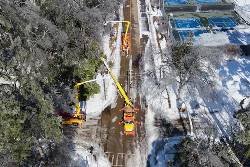
Around 90,000 outages remained in Nashville, Tennessee, where downed trees and snapped power lines blocked access to some areas. Utility workers will need at least the weekend, if not longer, to finish restoring power, said Brent Baker, a Nashville Electric Service vice president.
Forecasters say the subfreezing weather will persist in the eastern U.S. into February, with a new influx of arctic air arriving this weekend. There’s a growing chance for heavy snow in the Carolinas and Virginia.
The National Weather Service said chances of additional, significant snowfall are low in places like Nashville, but weekend temperatures will reach dangerously low single digits with wind chills below zero.
Mississippi dispatched 135 snowplows and National Guard troops equipped with wreckers to sections of Interstates 55 and 22 gridlocked by vehicles abandoned in the state’s ice-stricken northern region.
Cars and semitrucks trying to navigate the frozen highways single-file began getting stuck Tuesday. No injuries were reported, the Mississippi Department of Public Safety said.
Road crews work to fully reopen interstates for travel
On Thursday, road crews “will continue to focus on opening all lanes of I-55 and I-22,” Mississippi Gov. Tate Reeves said. “Drivers are encouraged to remain off any open interstate in northern Mississippi unless it is an emergency.”
“Once you get the goods on the interstate, you can’t branch out and get it anywhere else where it needs to be,” said Parttridge, who described I-55 as “our lifeline.”
Parttridge spent 36 agonizing hours not knowing how his parents, in their 70s, were after they lost heat, lights and cellphone service at their home about 25 miles (40 kilometers) away. Bates said he felt helpless not being able to reach them.
“Imagine the roadways blocked,” he said. “You can’t get to your family members, and then you can’t reach them to make sure if they’re OK. … I can’t imagine someone with an infant in this.”
Meanwhile, the University of Mississippi is extending the time it will be closed for all classes and activities and now does not plan to reopen until Feb 9.
Crews at the main campus in Oxford have begun removing “dangerous hanging limbs” from the campus, with initial work focusing on central campus and residence hall areas. Power has been restored to all of the campus, the university said in an update to students and employees Wednesday night.
Erik Lipsett in Benton County, Mississippi, spent the last several days scooping ice from the front yard so he can melt it to flush down his toilets. The area has been without water and power since the weekend.
On Wednesday morning, he lined up at a nearby gas station to shower and said that propane bottles, canisters and hookups for heaters are hard to come by.
___
Bynum reported from Savannah, Georgia. Martin reported from Atlanta. Associated Press writers Adrian Sainz in Memphis, Tennessee; Jeff Amy and Charlotte Kramon in Atlanta; Jonathan Mattise and Travis Loller in Nashville, Tennessee; Hallie Golden in Seattle; and Sarah Brumfield in Washington contributed to this report.
... Copyright © 1996 - 2026 CoreComm Internet Services, Inc. All Rights Reserved. | View our