

BOGOTA, Colombia (AP) — The trial is due to start Tuesday for five men over the killing of an Indigenous Amazon leader, in a rare legal case that prosecutors and advocates say could test whether Peru can hold perpetrators accountable for violence linked to illegal logging and drug trafficking in one of the world’s most dangerous regions for environmental defenders.
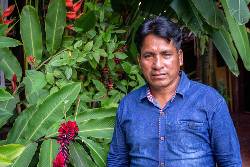
Kichwa tribal leader Quinto Inuma Alvarado, 50, was killed on Nov. 29, 2023, after repeatedly denouncing illegal activity within his community’s territory.
Prosecutors are seeking life sentences under charges of contract killing, a first in a case involving the murder of an Indigenous environmental defender in Peru.
The trial is being closely watched by Indigenous groups, environmental advocates and international observers as a test of whether Peru can curb violence tied to illegal deforestation and drug trafficking in the Amazon, where community leaders who defend forests and land rights often face threats with little protection and few cases ever reaching court.
“My father was deeply committed to his territory and his community,” said 30-year-old Kevin Arnol Inuma. “Being a real environmental defender requires a lot of sacrifice — walking through the forest, in sun and rain, and exposing yourself to danger.”
Kevin said his father — from Santa Rosillo de Yanayacu, in Peru’s northern Amazon region of San Martin — had received repeated threats for opposing illegal activities and was aware of the risks.
"He used to tell us that one day they might kill him and that we should be prepared,” he told The Associated Press.
Ambushed and killed
The killing of Inuma followed years of threats and official warnings that went unheeded, according to Cristina Gavancho, a lawyer with the Lima-based Instituto de Defensa Legal, which has accompanied Indigenous organizations and victims’ families since the killing.
“What happened was a result that was already foreseeable,” she said. “He was returning to his community after participating in an event for defenders and Indigenous people, and he was ambushed and killed.”
Prosecutors allege that the perpetrators, believed to have been illegal loggers, targeted Inuma because of his role defending Indigenous land and reporting illegal activities to authorities.
The attack occurred as Inuma traveled by boat along a river route used to reach his community. He was shot during the ambush and fell into the river, Gavancho said. Another community member was wounded and survived.
Five of the six suspects originally charged will face trial. A sixth suspect was killed in an attempted arrest last year during which he attacked police officers with a machete, Gavancho said.
Prosecutors say they have built a strong case, including forensic gunshot-residue tests and witness testimony placing the accused at the scene around the time of the killing. Investigators also link the suspects to individuals Inuma had repeatedly reported to authorities for illegal logging and drug trafficking.
If the court hands down life sentences, Gavancho says it would mark an unprecedented outcome in Peru for the killing of an Indigenous environmental defender, a ruling advocates say could send a strong signal that such crimes will no longer go unpunished in Peru and potentially further afield in Latin America.
‘This case is significant’
While high-profile killings of environmental defenders in countries like Brazil, Honduras and the Philippines have led to arrests or prosecutions, advocates say they have seldom resulted in outcomes seen as setting lasting precedents. The 2022 killing in Brazil of British journalist Dom Phillips and Indigenous expert Bruno Pereira led to multiple charges but has yet to yield a ruling widely viewed as precedent-setting.
Legal experts say the Peru case could mark a rare break from the rife impunity in attacks on Indigenous environmental defenders.
“This case is significant because it is the opportunity that the Peruvian state has to establish an exemplary sanction,” Gavancho said.
At least 35 Indigenous defenders have been killed in Peru over the past decade, according to Indigenous organizations and human rights groups, including Global Witness.
Gavancho said convictions in this case could have implications beyond the country, helping show that thorough investigations are possible and that lack of resources should no longer be used to justify impunity in killings linked to illegal logging, drug trafficking and mining across the Amazon.
Criticism over protection mechanisms
Kevin Inuma said his father's death forced his family to leave their community and adapt to life in the city, where they lost their home, crops and way of life.
“Living in the city feels like being imprisoned,” he said. “It is not our territory, and it has been very hard for our family.”
He said the family now depends on money for basic needs such as food, health care and education — a sharp contrast to life in the forest, where they relied on farming and communal support.
The case has also drawn attention to the failure of Peru’s system for protecting environmental and Indigenous defenders. Inuma had been granted a security detail under a state protection mechanism created in 2021, but those measures were never implemented.
Violence against environmental and Indigenous defenders is widespread across Latin America, said Matías Pérez Ojea del Arco, advocacy coordinator for Peru at Forest Peoples Programme, who described the region as the most dangerous in the world for people defending land and the environment.
He said the case highlights the failure of state protection mechanisms.
“Quinto Inuma had all the paperwork that was supposed to protect his life, and he was still killed,” Pérez Ojea del Arco said.
“These protection mechanisms stay on paper,” he added. “Paper does not stop bullets.”
Gavancho echoed that, saying “the Peruvian state does nothing” when it comes to preventing the killing of defenders.
“The protection that was ordered was never carried out due to lack of budget.” She said the state has acknowledged those failures before the Inter-American Commission on Human Rights and United Nations rapporteurs.
‘Won’t bring my father back’
While Peru’s government has not issued public comments on the trial, state institutions have previously said they were investigating the killing and identifying those responsible. Peru’s Ministry of Culture, responsible for the protection of Indigenous peoples, did not immediately respond for a request to comment.
International bodies are closely watching the proceedings. The Inter-American Commission on Human Rights granted precautionary measures to the community in early 2024, and U.N. rapporteurs have urged Peru to ensure justice.
Mary Lawlor, the United Nations Special Rapporteur on the situation of human rights defenders, told AP the investigation itself already represents a rare step forward.
“So often where people are killed for defending human rights the crime is never investigated, and the perpetrators are never prosecuted,” Lawlor said. “The fact that the state’s investigation has identified both the alleged perpetrators and alleged intellectual authors behind Quinto’s killing is, sadly, ground breaking.”
Lawlor said she would monitor the trial and expressed hope that it would “mark a new chapter in the prosecution of attacks and threats against human rights defenders in the country.”
Kevin Inuma says the trial cannot undo what his family has lost.
“Even if there is justice, it won’t bring my father back,” he said. “We will never see him again.”
___
The Associated Press’ climate and environmental coverage receives financial support from multiple private foundations. AP is solely responsible for all content. Find AP’s standards for working with philanthropies, a list of supporters and funded coverage areas at AP.org.
... Copyright © 1996 - 2026 CoreComm Internet Services, Inc. All Rights Reserved. | View our