

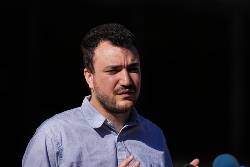
A federal appeals panel on Thursday reversed a lower court decision that released former Columbia University graduate student Mahmoud Khalil from an immigration jail, bringing the government one step closer to detaining and ultimately deporting the Palestinian activist.
A three-judge panel of the 3rd U.S. Circuit Court of Appeals in Philadelphia instructed the lower court to dismiss Khalil’s habeas petition, a court filing that secured his release. The panel ruled that the federal district court in New Jersey did not have jurisdiction over the matter because immigration challenges are handled differently under the law.
In a 2-1 decision, the panel ruled that federal immigration laws require deportation challenges to be made by filing a petition for review of a final order of removal with a federal appeals court — not a lower-level district court.
“That scheme ensures that petitioners get just one bite at the apple—not zero or two,” the panel wrote. “But it also means that some petitioners, like Khalil, will have to wait to seek relief for allegedly unlawful government conduct.”
The law bars Khalil “from attacking his detention and removal in a habeas petition,” the panel added.
Messages sent to Khalil and his legal team were not immediately returned.
The decision marked a major win for the Trump administration’s sweeping campaign to detain and deport noncitizens who joined protests against Israel.
It is likely not the final word in Khalil’s multipronged legal battle. Lawyers for the 30-year-old Palestinian activist have said they will exhaust all appeal options.
An outspoken leader of the pro-Palestinian movement at Columbia, Khalil was arrested at his apartment on March 8, 2025. He then spent three months detained in a Louisiana immigration jail, missing the birth of his firstborn son.
Federal officials have accused Khalil of leading activities “aligned to Hamas,” though they have not presented evidence to back up the claim and have not accused him of criminal conduct.
The government has justified the arrest under a seldom-used statute that allows for the expulsion of noncitizens whose beliefs are deemed to pose a threat to U.S. foreign policy interests.
In June, a federal judge in New Jersey ruled that justification would likely be declared unconstitutional and ordered Khalil released.
President Donald Trump's administration then appealed that ruling, arguing the deportation decision should ultimately fall to an immigration judge, rather than a federal court. They have also accused Khalil of failing to disclose information on his green card application.
Khalil has dismissed those allegations as “baseless and ridiculous,” framing his arrest and detention as a “direct consequence of exercising my right to free speech as I advocated for a free Palestine and an end to the genocide in Gaza.”
The appeals court decision comes as an appeals board in the immigration court system is weighing a previous order from an immigration judge that found Khalil could be deported. His attorneys have argued that the federal order should take precedence.
That judge has suggested that Khalil could be deported to Algeria, where he maintains citizenship through a distant relative, or Syria, where he was born in a refugee camp to a Palestinian family.
His attorneys have said he would face mortal danger if he were forced to return to either country.
... Copyright © 1996 - 2026 CoreComm Internet Services, Inc. All Rights Reserved. | View our