

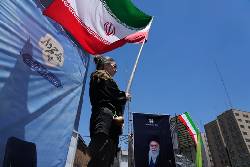
DUBAI, United Arab Emirates (AP) — An initial agreement between the United States and Iran to extend their shaky ceasefire inched toward a formal signing despite questions Monday over the fate of Tehran's nuclear program and an offensive by Israel in Lebanon that could prolong the fighting and scuttle the deal.
The agreement signed electronically Sunday is meant to provide a meaningful truce in a monthslong war that has killed thousands across the Middle East, including the top leaders of Iran's theocracy, and raised the prices of fuel, food and other basic goods far beyond the region. But logistical and military challenges underscored the fragile nature of the deal, which was set for a ceremonial signing Friday in Geneva.
At the core of the pact is a planned reopening of the Strait of Hormuz, a crucial waterway whose blockage has choked the supply of the world's oil and natural gas. Yet even a full reopening would not immediately alleviate the global energy crisis its closure created.
Another potential obstacle concerns Israel, which joined the U.S. in launching the war on Feb. 28, but it is not party to the deal. The Israeli military launched airstrikes Sunday in southern Lebanon, where it is fighting the Iranian-backed Hezbollah militant group, and the Israeli defense minister said Monday that the country would not withdraw from land seized in Lebanon, where Israel is fighting the Iranian-backed Hezbollah militant group.
Israeli Prime Minister Benjamin Netanyahu on Monday said the agreement between the U.S. and Iran was Trump's decision. Netanyahu said Israel has its own interests, primarily protecting against a potential nuclear threat from Iran. He said Iran wanted Israel to withdraw from Lebanon, but he stood firm, saying Israel would remain in the buffer zone “as long as necessary.”
“I tell you, citizens of Israel, the struggle is not over. We will need to continue to be vigilant, to remain strong and determined, to defend ourselves as necessary,” he said.
Other uncertainties center on Iran's stockpile of highly enriched uranium, which the U.S. and Israel worry could be used to build an atomic weapon despite Tehran's insistence for years that it has no aspirations to do so. The deal gives Iran just 60 days to decide what to do with its supply. It took years for Iran and world powers to negotiate a 2015 agreement to rein in Tehran’s nuclear program.
President Donald Trump unilaterally withdrew the U.S. from that accord in his first term, setting the stage for the tensions that culminated in the current war.
The Strait of Hormuz won't open until the deal is signed
Early in the war, Iranian attacks on ships brought traffic in the Strait of Hormuz — through which a fifth of the world’s oil and natural gas passed before the conflict — to a near standstill. Trump implemented a blockade in response.
Iran’s deputy foreign minister, Kazem Gharibabadi, said Iran would not start implementing the agreement until after the signing ceremony. The U.S. military said the blockade will remain in place “pending execution” of the deal.
“Do not attempt to cross until explicit direction is given,” it said Monday in an advisory to merchant ships.
Trump, who faced pressure to end the war ahead of congressional midterm elections in November, said that “a lot of great things are going to happen in the Middle East right now.”
“Very importantly, the oil is plummeting down, and the stock market is shooting up like a rocket today,” he said Monday at the G7 summit in France.
While the agreement provides for the “immediate” opening of the strait and lifting of the blockade, the process will take time because there are mines in the strait, and ships are unwilling to risk traversing it, according to a senior U.S. official who spoke to reporters on condition of anonymity to discuss outlines of the agreement.
Details remain scant but expected soon
A second senior U.S. official told reporters that details of the agreement would be released within the next two days.
The memorandum of understanding includes the possibility of releasing Iran’s frozen funds, easing sanctions and creating a $300 billion fund to rebuild Iran — all of which would be tied to Iran meeting benchmarks, the official said.
The officials said technical talks would begin Friday after the signing ceremony and that Vice President JD Vance would lead negotiations for the U.S.
Israel says it won't withdraw from Lebanon
The success of the deal rests at least partially on what happens between Israel and Hezbollah in Lebanon. Israel’s bombing of Beirut’s southern suburbs on Sunday nearly derailed the negotiations, and a previous attack led Iran to fire on Israel and Israel to fire back.
Defense Minister Israel Katz said Israel plans to stay “indefinitely” in land it holds in Lebanon, Syria and the Gaza Strip. He also threatened that if Iran attacks Israel over its strikes in Lebanon, Israel will strike Iran with “great force.”
Asked where Israel stands on the deal, David Mencer, a spokesman in Netanyahu’s office, told The Associated Press that Israel and the U.S. remain fully aligned on preventing Iran from obtaining nuclear weapons. But he added that Israel will not tolerate attacks from Hezbollah on its territory.
Israel and the U.S. began the war apparently in lockstep, but the war has created deep fractures in that close relationship, with Trump eager to end a conflict that is deeply unpopular with the American public and Netanyahu intent on destroying Hezbollah. Trump appears to have grown increasingly frustrated with the Israeli leader, even occasionally publicly insulting him, including telling The New York Times on Sunday that he was a “very difficult guy.”
Many Lebanese travel to check on homes
In a sign of the deal's fragility, the Lebanese army called on residents not to rush to return to border villages, saying they should follow military instructions because of the danger of “Israeli violations and aggression.”
Many Lebanese who had fled following Israeli evacuation orders and intense fighting were heading south, however, to check on their homes. Celine Fayad, driving south, said she will test how far she could go. Her village, Aitaroun, is along the border with Israel. It was among the first to be occupied and lies in ruins.
“We were expecting to return,” she said. “Thanks to Iran.”
Ali Haidar was among the first to return to Nabatiyeh, the southern city at the heart of the latest Israeli military operations, where many central buildings have been reduced to dust.
“This used to be our home, our childhood home where we have all of our memories. This is where we grew up. Now it’s gone,” Haidar said. “We will return to rubble and sand. It’s better than being displaced.”
Hezbollah, meanwhile, credited Iran with a “major achievement” in reaching the agreement, which it said could lead to “the full liberation of our land, the return of our prisoners to their homeland and families," and reconstruction of war-devastated areas.
Along with praising the deal, the militant group said it was committed to resisting Israel “until full withdrawal is achieved.”
___
Becatoros reported from Athens, Greece. Price reported from Washington. Associated Press writers Munir Ahmed in Islamabad; Will Weissert and Aamer Madhani in Washington; Julia Frankel in Jerusalem; Abby Sewell and Sarah El Deeb in Beirut; Najib Jobain in Doha, Qatar; Melanie Lidman in Tel Aviv, Israel; and Sylvie Corbet in Evian-les-Bains, France, contributed to this report.
... Copyright © 1996 - 2026 CoreComm Internet Services, Inc. All Rights Reserved. | View our