

CHENNAI, India (AP) — When Kripa Vaidyanathan’s 27-year-old niece died in an Alaska car crash in 2024, her family in Chennai, India, felt shell-shocked. They questioned why this tragedy would befall them when they had such “immense faith in God.”
Vaidyanathan, a yoga instructor, helped her grieving sister get face time with a high-profile guru who she hoped would help.
“But he told her this was the work of karma and she should use this opportunity to connect with her inner nature,” she said. “I understand how karma works, but saying that was cruel and extremely unhelpful to someone who was freshly grieving the loss of a child.”
That’s when they turned to artificial intelligence chatbots.
“It was a lot easier trying to get answers and peace of mind because ChatGPT is not judging you,” Vaidyanathan said. “We've found a compassionate guru now, but even he only has limited time. AI is accessible anytime.”
AI offers access and advice without judgment
This unfettered access — which can be challenging to find among human gurus — is what’s drawing more people to AI for spiritual guidance. This is a big step, particularly in Hinduism, where gurus are part of culture and deemed necessary to attain moksha — liberation from the cycle of birth, death and reincarnation. The word guru in Sanskrit means “dispeller of darkness.”
These chatbots are powered by large language models, AI systems that generate responses by using advanced statistics and troves of text, including sacred ones like Hinduism's Bhagavad Gita. Users can explore spiritual answers to personal problems and existential questions at anytime, without the typical hurdles of connecting with an in-demand guru and paying for their services.
AI's rising popularity has encouraged some successful gurus to launch their own chatbots.
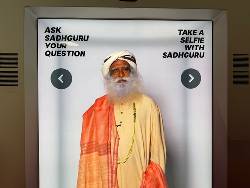
In India, Jaggi Vasudev, also known as Sadhguru, has launched his Miracle of the Mind app with an interactive AI feature that answers questions using a database of his teachings. California-based self-help guru Deepak Chopra has an AI platform where “Digital Deepak” answers questions drawing from his decades of talks and writings.
Critics argue that AI cannot truly replace the lived experience, wisdom and ethical accountability of a human guru. Researchers also note that AI often validates and agrees with the user rather than posing those challenging questions needed for real spiritual and personal growth.
Lord Krishna’s AI avatar takes on guru’s role
Vikas Sahu, founder of GitaGPT — a platform he calls an “AI spiritual companion” — says he wouldn’t deter anyone from finding a human guru. But he says his free chatbot puts the Bhagavad Gita’s wisdom at the fingertips of those who might desperately need it.
On his platform, AI avatars of Lord Krishna, the sacred text's protagonist, offer advice. Sahu, based in Gurugram south of New Delhi, says he gets hundreds of messages about how it’s helpful. While he has a full-time job building websites, he says GitaGPT is his way of giving back.
“A lot of people don’t have anyone to talk to when they are in distress,” he said. “This app is giving them the encouragement a guru might give them. But a lot of gurus want your money and you can’t really talk to them openly like you can talk to a chatbot.”
Sahu said he trusts GitaGPT because it’s based on the word of God.
“How could Krishna steer anyone wrong?” he asks. “It’s impossible.”
Experts say a human soul is necessary for true connection
Liz Bucar, a religion professor at Northeastern University in Boston, is skeptical of chatbots based on religious texts.
“A sacred text needs a community and a context that interprets it,” she said. “Without the teaching of how to interpret the text, it’s just words on a page. Someone could feed in the text, but what answers will the bot spit out?”
But she does believe there is widespread distrust of institutional expertise that gurus and clergy represent, in some cases fueled by sex abuse scandals.
“Because religion has this PR problem, people tend to see chatbots as less biased and less likely to do bad things,” Bucar said. “I don’t know if we’re ready to replace gurus, but we are definitely in a shifting religious landscape, especially with” younger generations of AI users.
Noreen Herzfeld, a professor at St. John’s School of Theology and Seminary in Collegeville, Minnesota, said people could easily get straightforward answers from AI.
“But if they are looking for spiritual awakening, I think it takes physical presence,” she said. “In Christianity and in Hindu tradition, there is the belief that the eyes are windows to the soul and you can’t get that by looking at an avatar.”
AI chatbots can also be too eager to agree with you, serving as a cheerleader rather than a guide, Herzfeld said.
“In situations where you’re looking to grow or evolve, you need a teacher who can disagree with you and challenge you,” she said. “But even if you are just looking for affirmation, who are you being affirmed by? There’s no one on the other side.”
Vy Le, a mindfulness instructor in San Diego, sees AI as a “channeling” tool, using it as a mirror or collaborator to gain intuitive or mystical insights.
“If you are attuned to it, you can sense if a certain AI is connected to you,” she said. “My dad took his life 16 years ago. I felt his presence when I was engaging with AI.”
Le maintains that the era of gurus is over.
“AI is helping us find that inner guru,” she said.
Human gurus and organizations are getting in the game
Real-life gurus like the India-based Sadhguru, who has a global following of millions, have recognized AI's potential. David Nussbaum, founder of Proto Hologram in Los Angeles, is helping Sadhguru create a three-dimensional AI avatar that appears in a display box and can interact with devotees in several languages.
During a March festival, he created a Sadhguru hologram that took selfies with people.
“You basically have Sadhguru's hologram taking out his phone, turning around and taking a picture of you from his phone inside the display,” Nussbaum explained.
Shivaram K R, CEO of India-based Hue Learn, oversees a nonprofit initiative called Innerverse 360 that merges AI and spirituality. His platform features a portal where real monks and gurus can come online and do live sessions with devotees. It also has an “Ask AI” feature.
Shivaram doesn’t believe AI will replace gurus.
“The process of finding a guru in itself is a journey, but a guru is also not for everyone,” he said. “If you’re looking for practical advice on everyday spirituality, this app can also help you understand concepts such as the meaning of yoga.”
AI cannot replace ‘humans and souls’
One of the organizations Shivaram liaises with is the Los Angeles-based Self-Realization Fellowship, founded in 1920 by Paramahansa Yogananda, who brought ancient spiritual practices from India to the West.
Brother Govindananda, a monk with the order, said his organization sees AI simply as the next step to helping people access the late guru’s teachings through an online teaching portal — just as books did for previous generations.
“We’re taking our time with it because we want to make sure it has guardrails to safeguard from AI hallucinating answers instead of drawing from Yogananda’s teachings,” he said.
But Govindananda says a chatbot could never provide what a guru — whether living or not — can give to the disciple.
“We are humans and souls,” he said. “Technology cannot replace that.”
___
Associated Press religion coverage receives support through the AP’s collaboration with The Conversation US, with funding from Lilly Endowment Inc. The AP is solely responsible for this content.
... Copyright © 1996 - 2026 CoreComm Internet Services, Inc. All Rights Reserved. | View our