

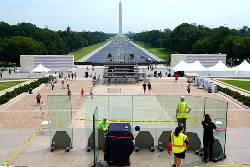
WASHINGTON (AP) — Thousands of protesters are expected on the National Mall on Friday for a rally in support of voting rights and racial justice ahead of the midterm elections, following a wave of changes to voting laws and redistricting that civil rights groups have condemned as detrimental to Black Americans.
The 2026 “Defend the Vote” March on Washington, organized by the Rev. Al Sharpton and Martin Luther King III, will echo the Rev. Martin Luther King Jr.'s 1963 march. The event follows the U.S. Supreme Court’s landmark April decision in Louisiana v. Callais that reinterpreted key provisions of the Voting Rights Act of 1965, allowing Southern states to redraw their congressional maps in a way that erodes equal representation in Black communities.
“We’ve been doing these marches for years, but this is probably the most important because this is the first year we are marching that the voting rights bill has been nullified by the Supreme Court,” Sharpton, founder of the National Action Network, said in an interview with The Associated Press.
“Marches are designed to grab attention and then go into the trenches and organize around that,” he said.
This year’s march, which Sharpton's group is co-hosting with King's Drum Major Institute, a progressive think tank and community action group, will feature dozens of speakers, including Sen. Bernie Sanders, I-Vt., Virginia Gov. Abigail Spanberger and Rep. Alexandria Ocasio-Cortez, D-N.Y.
Thousands of civil rights activists from across the southeastern U.S. are traveling to the capital by bus for the rally, Sharpton said.
Event echoes iconic rally at Lincoln Memorial
The event harkens back to King Jr.’s historic March on Washington for Jobs and Freedom in 1963, when more than 200,000 people gathered at the foot of the Lincoln Memorial. That march, an inflection point in the Civil Rights Movement, also came at a fraught moment for the country, when economic headwinds, civil unrest, political division and the war in Vietnam bitterly divided Americans.
For this year's march, Sharpton said the Trump administration’s immigration policy for Haitians and white South Africans, as well as cuts to social programs like Medicaid and the Affordable Care Act’s health subsidies, are unifying policies for ideologically diverse march attendees. But the unusual redistricting efforts by Republican-led states set to reduce the number of Black lawmakers in Congress loom large over Friday's march.
“This march is about people who refuse to be counted out. When the courts and the legislature broke apart District 6, they did not just redraw lines,” Rep. Cleo Fields, D-La., said in a texted statement. “They told hundreds of thousands of Black families from Baton Rouge up through the Delta that their voice could be taken away at any moment.”
Fields was the central character in the April Supreme Court decision that hollowed out the Voting Rights Act of 1965. The court ruled that his district, created just one term ago to permit a second majority-Black district in a state where Blacks make up 33% of the population, was unconstitutional because it relied too heavily on race.
The court has held that maps can be redrawn for partisan reasons.
Louisiana's state legislature rushed to redraw the district after the high court's decision. The new map redraws Fields’ district to cluster it around predominantly white communities in the Baton Rouge area and southern Louisiana.
Fields has opted not to seek reelection to Congress and instead is pursuing a seat in the state Senate.
“The people taking part in this historic march are answering back, and history will remember that they did,” Fields said.
Embattled Black lawmakers see need for continued rights push
Rep. Shomari Figures, an Alabama Democrat whose majority-Black district was targeted by the state’s Republican-led redistricting effort, said the original voting rights fight required local movements, national figures, lots of coordination and strategy. He sees this year's march as a continuation of that legacy.
“My district includes Montgomery, which was the birthplace of it all. It started with a bus boycott in 1955 and that, ultimately, morphed into a broader struggle for civil rights and led to a more broad Civil Rights Movement,” Figures told the AP.
“It led to a Civil Rights Act, led to the Fair Housing Act, led obviously to the Voting Rights Act, and the voting rights movement,” Figures added.
Ahead of Friday, organizations participating in the march, including the NAACP, the Lawyers’ Committee for Civil Rights Under Law, and Black Voters Matter, filed new claims in federal court as part of their existing lawsuit against President Donald Trump's executive order restricting mail-in voting. The Supreme Court cleared a path Monday for possible implementation of the order, though it remains unclear how much can be put in place before the midterms.
“We will not stand idly by while the voices of the people are silenced,” NAACP President Derrick Johnson said in a statement Thursday. “We must protect every eligible citizen’s right to cast their ballot.”
____
Associated Press writers Gary Fields in Washington and Kimberly Chandler in Montgomery, Alabama, contributed.
... Copyright © 1996 - 2026 CoreComm Internet Services, Inc. All Rights Reserved. | View our