

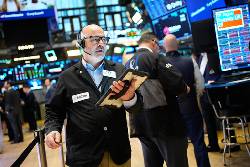
NEW YORK (AP) — U.S. stocks deepened their drops Friday as Wall Street finished off a fifth straight losing week, its longest such streak in nearly four years.
The S&P 500 fell 1.7% to close its worst week since the war with Iran began. The Dow Jones Industrial Average lost 793 points, or 1.7%, and fell more than 10% from its record set last month, while the Nasdaq composite sank 2.1%.
The losses were a break from Wall Street’s pattern this week, where the U.S. stock market flip-flopped from gains to losses each day as hopes rose and fell about a possible end to the war.
Moments after the U.S. stock market finished trading on Thursday, President Donald Trump offered more potential for optimism. He extended a self-imposed deadline to “obliterate” Iran’s power plants to April 6 if it doesn’t fully allow oil tankers to exit the Persian Gulf through the Strait of Hormuz to the open ocean.
Oil prices eased immediately afterward in a sign of hope that some normalcy may return to the strait. It was similar to the relief that swept markets Monday, when oil prices slid 10% after Trump announced the first delay to his deadline for clearing the Strait of Hormuz.
But oil prices resumed their climb as trading moved westward Friday from Asia to Europe and back to Wall Street. Despite Trump’s latest announcement, fighting continued in the Middle East. Iran gave no signs of backing down, and Israel threatened to “escalate and expand” its attacks on Iran.
“The diplomatic dissonance this week between the U.S. and Iran dismayed investors,” said Doug Beath, global equity strategist at Wells Fargo Investment Institute. “By the end of the week, risk appetite could not withstand the fog of war.”
“Any further statements by Trump about a deal are white noise to the markets,” Jim Bianco, president and macro strategist at Bianco Research, wrote in a social media post. “Only if the IRANIANS say the talks are going well will it impact markets.”
The price for a barrel of Brent crude oil climbed 3.4% to settle at $105.32. That’s up from roughly $70 just before the war began. Benchmark U.S. crude rose 5.5% to settle at $99.64 per barrel.
The fear in financial markets is that the war will disrupt the Persian Gulf’s energy industry for a long time. That could keep enough oil and natural gas out of the world’s markets to send a punishing wave of inflation through the global economy.
Not only would it raise prices for drivers buying gasoline, it could push businesses that use any trucks, ships or planes to move their products to raise their own prices. It would also make electricity from gas-fired power plants more expensive.
If the war continues until the end of June, strategists at Macquarie say the price of oil could reach $200 per barrel. The record is just above $147, set during the summer of 2008. That’s when Iran’s testing of missiles, including one that could reach Israel, and strong demand for oil from China helped send prices spiking despite the Great Recession.
High gasoline prices and the war are already hitting confidence among U.S. consumers, whose spending makes up the bulk of the economy. Sentiment among them fell slightly more in March from February than economists expected, according to a survey by the University of Michigan.
On Wall Street, most stocks fell, including three out of every four in the S&P 500. The index, which is the main measure of the U.S. stock market’s health, is 8.7% below its all-time high set in January.
Big Tech stocks were among the heaviest weights on the market, including drops of 4% for Amazon, 4% for Meta Platforms and 2.2% for Nvidia.
Companies selling things that are not essentials, which customers could stop buying if they’re spending much more on gasoline, also sank sharply. Norwegian Cruise Line Holdings lost 6.9%, Starbucks dropped 4.8% and Chipotle Mexican Grill sank 4.1%.
All told, the S&P 500 fell 108.31 points to 6,368.85. The Dow Jones Industrial Average dropped 793.47 to 45,166.64, and the Nasdaq composite sank 459.72 to 20,948.36. The Dow and Nasdaq are both down more than 10% from their records, a steep-enough drop that professional investors have a name for it: a “correction.”
In stock markets abroad, indexes fell in Europe following a mixed finish in Asia.
In the bond market, which has helped influence Trump’s actions in the past, Treasury yields swiveled.
The yield for the 10-year Treasury rose as high as 4.48% before pulling back to 4.43%. That’s up from 4.42% late Thursday and from just 3.97% before the war began. The rise has already sent rates jumping for mortgages and for other loans taken by U.S. households and businesses, slowing the economy.
High Treasury yields and disruption in the bond market were big factors that Trump named a year ago when he backed off his initial threats for global tariffs made on “Liberation Day.” The moves caused critics to allege Trump always chickens out, or “TACO,” if financial markets show enough pain.
___
AP Business Writers Chan Ho-him and Matt Ott contributed.
___
This version corrects the percentage decline for the S&P 500 index, which was 1.7%.
... Copyright © 1996 - 2026 CoreComm Internet Services, Inc. All Rights Reserved. | View our