

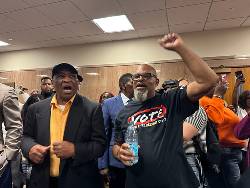
MONTGOMERY, Ala. (AP) — A national redistricting battle over U.S. House seats swung toward Republicans on Friday, as a Virginia court invalidated a Democratic gerrymandering effort and Republicans in other Southern states forged ahead with plans that could yield additional GOP seats in the November midterm elections.
Tensions ran high at times at the Alabama Statehouse, where the Senate was nearing a final vote on a plan to alter the state's congressional primaries if the courts allow Republican state officials to switch to a more advantageous U.S. House map. Meanwhile, Republican lawmakers in Louisiana and South Carolina also presented congressional redistricting plans that faced staunch opposition from civil rights activists and Democrats.
Republicans in Southern states have been moving quickly to try to capitalize on a recent U.S. Supreme Court ruling in a Louisiana case that significantly weakened Voting Rights Act protections for minorities. Tennessee enacted new congressional districts Thursday that carve up a Democratic-held, Black-majority district in Memphis.
Even before the high court ruling, Republicans and Democrats already were engaged in a fierce redistricting battle, each seeking an edge in the midterm elections that will determine control of the closely divided House. That battle tilted further toward Republicans when the Virginia Supreme Court ruled Friday that Democratic lawmakers had violated constitutional requirements when placing a redistricting amendment on the ballot.
Since President Donald Trump prodded Texas to redraw its congressional districts last summer, Republicans think they could gain as many as 14 seats from new districts in several states while Democrats think they could gain up to six seats. But the parties may not get everything they sought, because the gerrymandering could backfire in some highly competitive districts.
Alabama primaries could be in flux
Demonstrators outside the Alabama Statehouse on Friday shouted “fight for democracy” and “down with white supremacy.”
“I was out there in 1965 marching for the right to vote, and now we are back here in 2026 doing the same thing,” Betty White Boynton said.
During debate inside the statehouse, Black lawmakers sharply criticized Republican legislation that would ignore the May 19 primary for some congressional seats and direct the governor to schedule a new primary under revised districts, if a court allows it.
Republican Sen. Greg Albritton said the special primary would happen only if the courts agree to lift an injunction that put a court-selected map in place until after the 2030 Census.
“Should there be no court order issued, then this bill would have no effect,” Albritton said.
The court order required a second district where Black voters are the majority or close to it, resulting in the 2024 election of Democratic Rep. Shomari Figures, who is Black. If a court lifts the injunction, Republican officials want to put in place a map lawmakers drew in 2023 — which was rejected by a federal court — that could allow them to reclaim Figures’ district.
Senate Minority Leader Bobby Singleton, a Black Democrat, said Republicans are aiming to strip representation from Black voters in an effort to get another Republican to Congress.
“We have just only been voting since 1965, and you are now trying to take that voice away from us,” Singleton said.
Virginia ruling centered on timing of election
Democrats had hoped to gain as many as four additional U.S. House seats under new districts narrowly approved by voters in April. But the state Supreme Court invalidated the measure because it said the Democratic-led legislature violated procedural requirements.
To place a constitutional amendment before voters, the Virginia Constitution requires lawmakers to approve it in two separate legislative sessions, with a state election sandwiched in between. The legislature’s initial approval of the redistricting amendment occurred last October — while early voting was underway but before it concluded on the day of the general election. The legislature’s second vote on the amendment occurred after a new legislative session began in January.
The Supreme Court said the initial legislative approval came too late, noting that more than 1.3 million ballots already had been cast in the general election, about 40% of the total votes ultimately cast.
Louisiana lawmakers look at map options
A Louisiana Senate committee considered several redistricting options Friday, as voting rights activists packed the statehouse halls and filled multiple overflow rooms for the hearing. Protesters chanted “shut it down” as state senators discussed redistricting bills.
One bill, authored by Republican state Sen. John “Jay” Morris, would eliminate all majority Black districts in the state. Also under consideration are two bills from Morris allowing for one majority Black district, either centered around New Orleans or Baton Rouge. A majority Black district encompassing Baton Rouge would favor U.S. Rep. Cleo Fields, a Democrat who has forged ties with Republican Gov. Jeff Landry. A majority Black district centered on New Orleans would bolster Democratic U.S. Rep. Troy Carter.
State Sen. Gary Carter, a Democrat representing New Orleans, started the hearing by grilling Republicans on the fate of the tens of thousands of ballots already cast in Louisiana’s U.S. House primaries before they were suspended last week by Landry.
“My simple question is: What’s the status of those votes that’s already been cast? Are they going to be counted or are they going to be discarded?” Carter said
State Sen. Caleb Kleinpeter, who chairs the committee tasked with redistricting, said he did not have answers to those questions
South Carolina considers a House map
A small group of South Carolina lawmakers held a rare Friday meeting to discuss a proposed new congressional map intended to allow Republicans a clean sweep of the state’s seven U.S. House seats.
The hearing was the first step in redistricting. But the future of the effort remains murky. The state Senate has yet to agree to consider new districts later this month, an action that would require a two-thirds vote.
The new map has some Republicans nervous. Breaking up the 6th District, represented by Democratic U.S. Rep. Jim Clyburn, makes the other six districts less Republican.
At Friday’s subcommittee meeting, lawmakers heard hours of testimony, almost all against the new map. The hearing included a consultant who reviewed the map, saying it appeared to be legal under the Supreme Court's decision in the Louisiana case.
“I agree if the law allows us to do it, then we can do It,” Democratic state Rep. Justin Bamberg said. “But I can slap somebody’s mama and it’s not the right thing to do.”
Some absentee ballots already have been returned for the state's June 9 primary elections. The legislative subcommittee advanced a plan to delay the congressional primaries to August and reopen a candidate filing period, if a new map is approved.
___
Collins reported from Columbia, South Carolina; Brook from Baton Rouge, Louisiana; and Lieb from Jefferson City, Missouri.
... Copyright © 1996 - 2026 CoreComm Internet Services, Inc. All Rights Reserved. | View our