

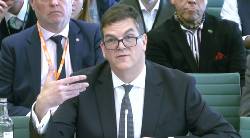
LONDON (AP) — The top official behind the decision to approve the appointment of Peter Mandelson as British ambassador to Washington said Tuesday that he felt political pressure from Prime Minister Keir Starmer's office to rush through the selection, despite security concerns.
Former Foreign Office head Olly Robbins said that Starmer's office had a “dismissive attitude” to security vetting of the scandal-tainted Mandelson. The testimony increases the heat on Starmer, who is facing calls to resign over the appointment of Mandelson, a friend of Jeffrey Epstein, to one of the U.K.'s most important diplomatic posts.
The prime minister fired Robbins last week after the revelation that Mandelson was approved for the job in January 2025 against the recommendation of the government's security vetting agency.
Robbins said that the concerns about Mandelson didn't relate to his relationship with Epstein. He declined to say when questioned by lawmakers what led the government's vetting agency to flag him as a potential security risk.
Mandelson had to resign twice from senior posts in previous Labour Party governments because of scandals over money or ethics. A separate background report prepared before he was appointed ambassador flagged potential business links to Russia and China as a concern.
Robbins said that the vetting agency considered Mandelson a “borderline case” and was “leaning toward recommending against” giving him security clearance. Robbins decided to clear him anyway.
Politicians wanted appointment approved
Starmer has called it “staggering” that Foreign Office officials failed to tell him about the security concerns, which he says he only found out about last week.
But Robbins said that the rules bar details of the sensitive vetting process from being shared except in “exceptional circumstances.”
Robbins told the House of Commons Foreign Affairs Committee that there was an “atmosphere of pressure” coming from Starmer’s office to approve the appointment so Mandelson could be in the post at the start of the second term of U.S. President Donald Trump.
Starmer announced the choice of Mandelson in December 2024, before intensive security checks were carried out. Robbins said that there was “a very, very strong expectation” that Mandelson “needed to be in post and in America as quickly as humanly possible” and “a generally dismissive attitude” to the security vetting from Starmer's office.
Robbins said that he was “very conscious” that refusing Mandelson security clearance would have caused “a real problem for the government and a problem for the country” in relations with the Trump administration.
Robbins insisted that his department “did not bow to that pressure.” He said that his decision to grant Mandelson clearance was based on security advice that the risks could be managed.
Robbins declined to identify any individuals as being behind the pressure. Starmer's chief of staff, Morgan McSweeney, a protégé of Mandelson, resigned in February, saying he took responsibility for the decision to appoint Mandelson.
The leader of the opposition Conservative Party, Kemi Badenoch, said that Robbins’ testimony “is devastating to Keir Starmer.”
She said that “it is now absolutely clear that ‘full due process’ was not followed. Keir Starmer has misled" the House of Commons — generally considered a resigning offense.
Starmer, who has denied misleading lawmakers, acknowledged on Monday that he made the wrong judgment when he picked Mandelson for the job. But Starmer said that he would have withdrawn the appointment if he’d known about the failed security vetting.
Starmer fired Mandelson in September, nine months into the job, when new details emerged about his friendship with Epstein, a convicted sex offender who died in prison in 2019.
The U.K. leader has ordered a review into any security concerns arising from Mandelson’s access to sensitive information while ambassador.
Questions over Starmer's judgment
Critics say the Mandelson appointment is more evidence of bad judgment by a prime minister who has made repeated missteps since he led Labour to a landslide election victory in July 2024.
He picked Mandelson as ambassador, despite being warned by his staff that Mandelson’s friendship with Epstein exposed the government to “reputational risk.”
But Mandelson's expertise as a former European Union trade chief and contacts among global elites were considered assets in dealing with the Trump administration.
The scandal has caused gloom among lawmakers in Starmer’s center-left Labour Party, already anxious about its dire poll ratings. Starmer already defused one potential crisis in February, when some Labour lawmakers urged him to resign over the Mandelson appointment.
Energy Secretary Ed Miliband said that he had raised concerns about the choice of ambassador, but didn’t think Starmer should resign over the debacle.
“If every time a prime minister made a mistake they resigned, we would shuttle through prime ministers like nobody’s business,” Miliband told the BBC.
Mandelson is under police investigation for suspected misconduct in public office after a trove of Epstein-related documents released by the U.S. Justice Department in January included emails suggesting that Mandelson had passed on sensitive — and potentially market-moving — government information to Epstein in 2009, after the global financial crisis.
British police launched a criminal investigation and arrested Mandelson in February. Mandelson has previously denied wrongdoing and hasn’t been charged. He doesn't face allegations of sexual misconduct.
... Copyright © 1996 - 2026 CoreComm Internet Services, Inc. All Rights Reserved. | View our